
A new roof does not automatically mean a neighborhood is ready for canvassing. The better question is: when should roofs trigger canvassing for your team, your market, and the specific streets around the job? Trigger a campaign when the completed job gives you a credible local reason to work an area - and when you can define, assign, and follow up on that area without creating overlap or wasted effort.
A roof replacement can be a strong starting point. It signals recent homeowner activity, gives your reps a visible reference point, and puts your company in a neighborhood where adjacent homes may share age, storm exposure, builder history, or maintenance needs. But the job itself is only the signal. A clear territory plan turns that signal into a campaign your team can actually work.
When should roofs trigger canvassing?
Use a completed roofing job as a canvassing trigger when three conditions are present: there is a clear neighborhood pattern worth investigating, your team has capacity to follow through, and you can draw a focused territory around the opportunity.
The strongest trigger is not simply, “We finished a roof here.” It is, “We finished a roof here, nearby homes have a reasonable connection to the opportunity, and we know exactly who owns this campaign.” That distinction matters. Randomly knocking a wide radius around every installation burns rep time and makes it difficult to measure what your team worked.
Start with the neighborhood. Look at the streets immediately surrounding the completed job, then consider what makes that pocket relevant. Homes built in the same period may be approaching similar replacement cycles. A recent weather event may have affected the same subdivision. A visible concentration of older roofs may justify a focused conversation. A dense neighborhood with closely grouped homes can be practical for canvassing, while a rural area with long driveways may be better suited to direct mail or a targeted outbound list.
A completed job should trigger canvassing when it gives your reps a specific, honest reason to introduce themselves. It should not be treated as proof that every nearby homeowner needs a roof. Your team still needs to inspect, listen, and qualify each conversation.
The situations that make a roofing job worth working
A local roof-age pattern is visible
If the completed job sits among homes built by the same developer within a short time frame, the area may be worth a campaign. Similar home age does not guarantee similar roof condition, but it gives you a practical reason to prioritize those streets before scattering effort across the city.
This is especially useful in subdivisions where roof replacements tend to cluster. A homeowner may not act immediately, but your team can introduce the company, note the completed local work, and build familiarity before the next need arises.
The job follows a storm or weather event
Storm response creates a different kind of trigger. If your company has completed work in an affected area, use the job location to identify the surrounding streets your team intends to cover. The key word is intends. Do not assume every nearby property suffered damage just because one roof was replaced.
A defined storm-response territory gives managers control over rep assignments and campaign timing. It also helps prevent the common problem of several reps working the same streets because everyone heard there was activity nearby.
Your crew creates visible neighborhood proof
A clean, completed installation can make canvassing more practical because homeowners can see that your company has recently worked nearby. This is most useful when your team moves quickly while the project is still current in the neighborhood.
Speed matters, but not at the expense of preparation. If the crew finishes on Friday and your canvassing team has no assigned area, no list, and no plan until two weeks later, the local reference is less timely. Build the territory while the job is active or immediately after completion so the campaign is ready when your reps are.
The location fits your service and sales model
Not every completed roof deserves the same effort. A company focused on a particular county, property type, or project size should use that filter before launching a campaign. A job outside your preferred service area may be worth referral activity or light follow-up, but not a full neighborhood push.
Likewise, a market with strict solicitation rules, gated access, or limited canvassing hours requires a different approach. Check local requirements, honor posted restrictions, and use contact information in line with applicable laws and your company’s outreach policies.
When a roof should not trigger canvassing
The wrong time to canvass is when the job is the only reason you have. If the surrounding area is too spread out, the homes do not fit your target market, or your team cannot follow up, save the effort for a more workable territory.
Avoid launching a broad campaign when ownership is unclear. A list without an assignee becomes a list no one works. The same applies when you already have existing contacts in the area but no visibility into them. Duplicate outreach and rep overlap can damage a good local opportunity.
You should also pause when the field signal is weak. One replacement in a neighborhood of much newer homes may be an isolated event. It could still generate referrals, but it may not justify a canvassing block. Treat a completed job as a reason to investigate the area, not an automatic command to blanket it.
Turn a completed job into a defined campaign
The operational goal is simple: turn your last roofing job into your next neighborhood campaign. That requires more than handing a rep an address.
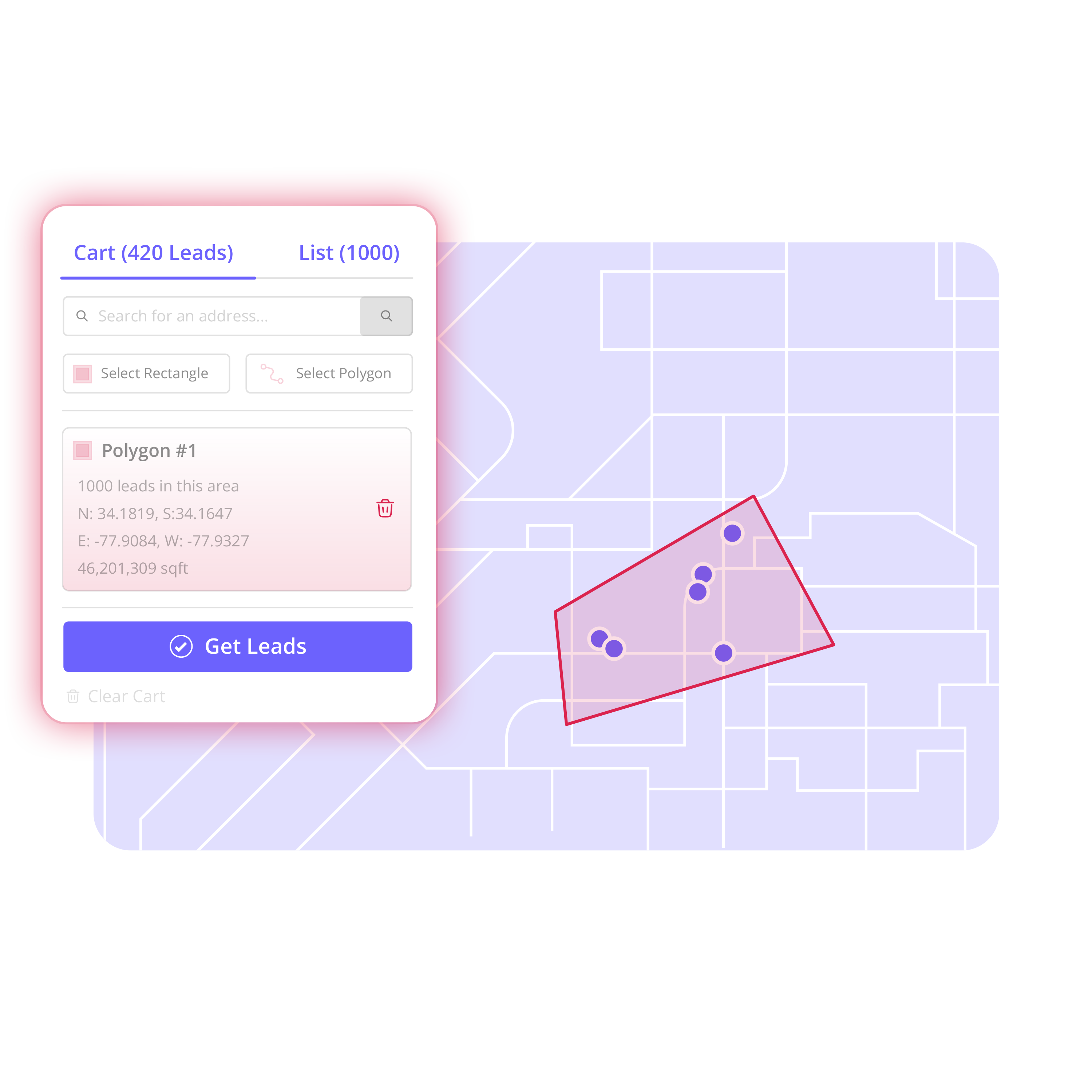
First, choose the area. Open the completed job location on a map and draw the streets your team realistically wants to work. Use a rectangle for a simple block or a polygon when you need to follow subdivision lines, exclude commercial parcels, or stop at a highway, creek, or neighborhood boundary. Build the territory around how people actually move through the area, not around an arbitrary radius.
Next, find the properties inside that boundary. Review available property records and remove obvious mismatches before the list grows. If your company works owner-occupied single-family homes, do not send a rep into a list filled with commercial buildings, vacant lots, or property types outside your model.
Then build the contact list. Select the properties that fit the campaign and create an Audience for that specific job-area effort. Give it a name your team can understand at a glance, such as “Oak Ridge - May Install - Canvass” or “Northside Storm Area - Block 1.” Clear naming helps managers distinguish a finished-job campaign from a storm list, a referral push, or a broader market-expansion effort.
Build the territory first. Enrich what matters. Available owner or contact information can help your team prepare for calls, direct mail, or follow-up, but you do not need to enrich every property before you decide whether it belongs in the campaign. Start with the best-fit records and add available information selectively.
Finally, organize the work. Assign the Audience or individual prospects to the right rep, set a usable status, and document relevant context. A note such as “recent install on Maple Drive” gives the rep a useful local reference without overstating what the prospect needs. If your team works from another sales or outreach system, export the organized records once the list is ready.
That is the practical workflow: search the map, draw an area, select leads, create an Audience, enrich, organize, and export. From map to prospect list, the goal is a campaign with a boundary, an owner, and a clear next action.
A simple decision standard for managers
Before you trigger canvassing around a roof, ask whether the opportunity passes a three-part test.
Is there a reason to work these particular streets? Is there a realistic way for the team to cover them soon? And can you keep the records organized so reps do not overlap or lose follow-up?
If the answer is yes, the completed job is more than a project marker. It is the starting point for a controlled local campaign. If the answer is no, narrow the area, change the channel, or wait for a better trigger.
Territory helps roofing teams choose the area and build the list without starting in a spreadsheet. The value is not in canvassing every home near every job. It is in giving your team a repeatable way to decide where to go next, prepare the right records, and work the neighborhood with clear ownership.
The next completed roof can create momentum, but only if someone turns that address into a plan. Choose the area. Build the list.