
A completed roof is more than a finished job. It is a clear signal that your crew, yard signs, and customer conversations have already put your company in front of a neighborhood. A roofing saturation campaign guide should start there: choose the streets around the job, build a defined prospect list, and give your team one organized area to work.
The goal is not to knock every door in a ZIP code or buy another generic list that needs hours of cleanup. The goal is to decide where your next conversations should happen, identify the properties in that area, and make sure every rep knows which records they own.
For a roofing company with 2 to 20 reps, that discipline matters. Without it, two reps work the same street, a homeowner appears in multiple spreadsheets, and a promising neighborhood campaign gets delayed while someone cleans data. Start with the neighborhood. Build the territory first. Enrich what matters.
What a roofing saturation campaign is meant to do
A roofing saturation campaign concentrates sales activity in a specific, manageable area. That area might be the blocks around a completed replacement, a subdivision with aging roofs, a storm-affected pocket, or a neighborhood where your crews are already active.
Saturation does not mean treating every property exactly the same. Some homes may be excluded because they are existing contacts, recently worked records, commercial properties, or simply outside the campaign boundary. The point is control. You choose the area, then build the list your team will actually use.
This approach works because roofing sales are visible and local. A homeowner may have seen a crew nearby, noticed a yard sign, or heard a neighbor discuss a recent replacement. That creates context for an introduction. It does not create permission to contact someone, and it does not guarantee interest. Your team still needs to follow applicable calling, texting, door-to-door, mail, and data-use requirements.
How to build a roofing saturation campaign
The best campaign begins with a geographic decision, not a spreadsheet. Work through the area in the same order your team will use it: define the boundary, select the properties, organize ownership, and prepare the data for outreach.
1. Start with a real roofing opportunity
Choose a starting point your team can explain in one sentence. For example: “We completed a roof on Oak Ridge Drive and want to work the surrounding three blocks this week.” Or: “Hail damage was reported in this subdivision, and we want a defined area for inspection outreach.”
Avoid vague instructions such as “work north of town” or “hit the neighborhoods near our last job.” Those directions produce overlapping territory, inconsistent follow-up, and unclear accountability.
Use the actual job address, a service-area pocket, or a known neighborhood entrance as the campaign center. Then decide the scale based on crew capacity. A two-person canvassing team may work a tight cluster of streets well. A larger sales group may need separate sections with clear boundaries. More properties are not automatically better if your team cannot work them promptly.
2. Draw the streets your team intends to work
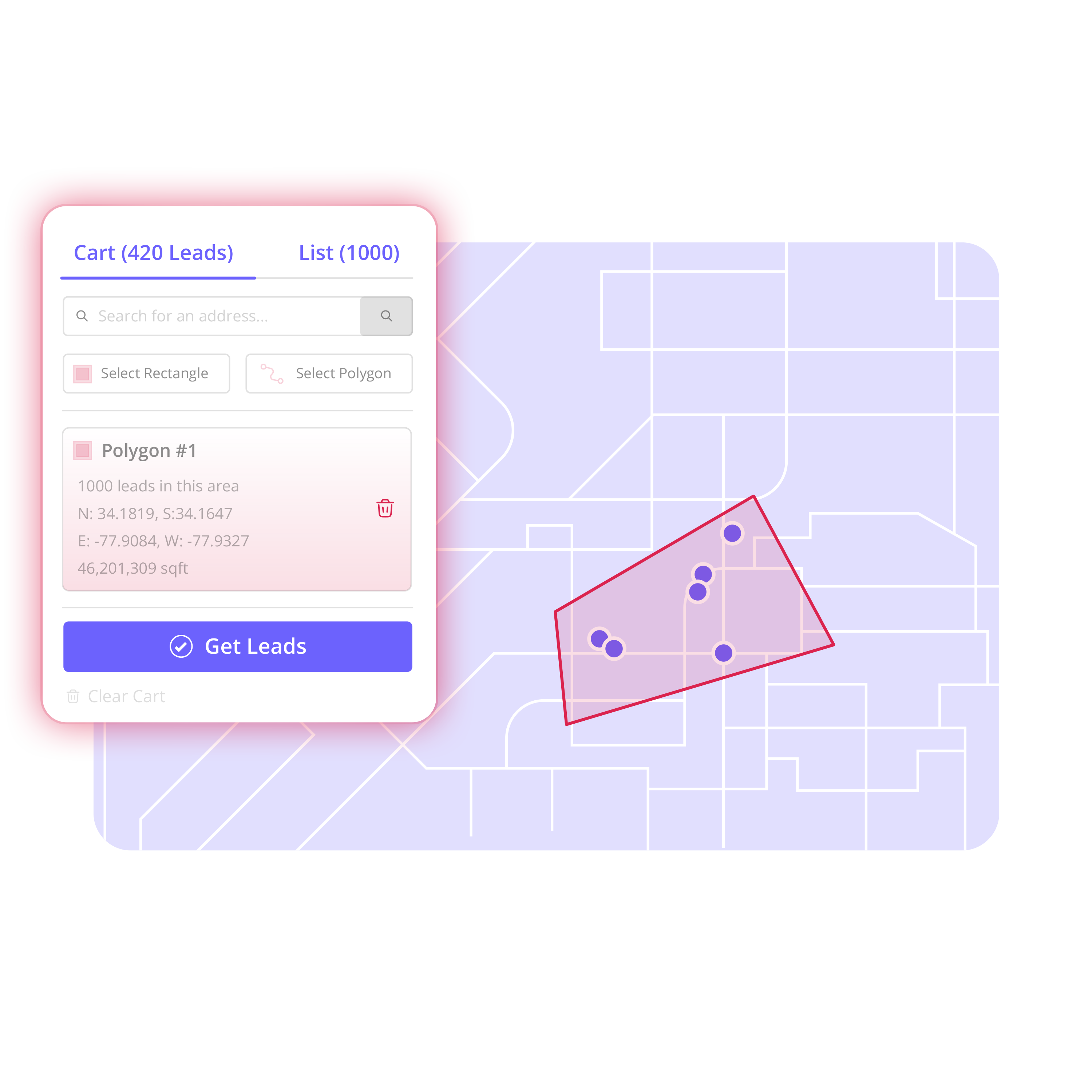
Draw a rectangle for a straightforward block area or use a polygon when the neighborhood boundary follows curving streets, a subdivision entrance, a highway, or a natural break. The important part is that the map reflects the territory your team actually intends to prospect.
A good boundary is operational. It is easy to describe, easy to assign, and easy for a manager to review. It may include the streets surrounding a completed job but exclude an apartment complex, a gated section, or an area assigned to another rep.
This is where a map-first workflow prevents common campaign mistakes. Rather than sorting a broad list by address and hoping it matches the neighborhood, you see the area first. Then you select the properties inside it. From map to prospect list, the geography stays intact.
3. Select properties and remove obvious noise
Once the area is drawn, review the available properties before adding them to the campaign. Existing-contact overlays are useful here. If a home is already in your pipeline, has an active inspection, or was recently contacted, your team should see that before creating another record or assigning a duplicate task.
Also decide what does not belong. A roof replacement campaign around a residential job may exclude commercial buildings, multifamily properties, vacant lots, or addresses that fall outside the rep’s assigned section. A storm-response campaign may use a wider boundary but still need separate groups for different neighborhoods.
Do not make selection a one-time, thoughtless bulk action. A clean campaign starts with purposeful inclusion. That reduces the cleanup your sales manager handles later and gives reps a list they can trust.
4. Create an Audience before you enrich
Put the selected properties into a named Audience. Use a name your team can understand without opening a map, such as “Oak Ridge - Completed Job - Week of May 12” or “Westfield Hail Area - Section A.” Include the campaign purpose and, when useful, the owner or time frame.
An Audience turns a set of map selections into a working prospect group. It gives the campaign a home where managers can review the records, salespeople can see their assignments, and operations can keep the original territory intact.
This step also prevents the familiar spreadsheet problem: a list gets exported, copied, renamed, and passed between people until nobody knows which version is current. Build one organized group first. Then decide how it will be worked.
5. Enrich only the records that matter
Not every property needs the same level of preparation. If your team is door knocking, a street address and clear ownership may be enough to begin. If you are preparing phone outreach, direct mail, or a mixed campaign, selectively add available homeowner or property-owner contact information to the records that fit the effort.
That is a better use of budget and time than enriching a large area before you have even decided which homes your team will pursue. Build the territory first. Enrich what matters.
Available contact information is not proof that a person requested contact or consented to a particular outreach channel. Establish your own process for compliance, suppression lists, do-not-contact requests, and campaign rules. The operational value is having cleaner data for the outreach methods your business is permitted to use.
6. Assign ownership before the campaign starts
A saturation campaign fails when ownership is unclear. If three reps believe a street is open, you do not have coverage. You have overlap.
Assign prospects by block, street, or campaign section. For a small team, that may mean assigning the full Audience to one rep with a manager overseeing progress. For a larger operation, split the neighborhood into logical sections that follow the map, not arbitrary record counts that scatter a rep across town.
Use statuses and notes to keep the work visible. A simple set of stages can be enough: unworked, attempted, follow-up, inspection set, not interested, and do not contact. The exact labels depend on your process, but everyone should use the same definitions. A status only helps if it tells the next person what happened and what should happen next.
7. Export clean data or keep working from the campaign
When the list is ready, export the campaign-ready data into the sales or outreach tools your team already uses. Keep the export tied to the Audience name so you can trace it back to the original map area.
You may not need to export immediately. Some teams prefer to continue organizing records, reviewing contact profiles, updating notes, and managing assignments in one place before moving selected data elsewhere. It depends on how your sales process is set up.
Either way, avoid exporting raw data too early. An unfiltered file creates more work downstream. A defined territory with selected properties, clear ownership, and only the needed contact information is more useful than a large list with no campaign plan.
A practical completed-job example
Say your crew finishes a roof in a 1990s subdivision on Thursday. The sales manager wants two reps to work the area Friday afternoon and follow up the next week.
First, locate the completed job on the map. Draw the surrounding streets, stopping at the main road and excluding the adjacent townhome community. Review the available properties and check for records already in progress. Select the remaining homes and create an Audience named for the neighborhood and completed job.
Next, divide the streets into two clear sections. Assign each section to a rep. Add available contact information only where the follow-up plan calls for it, and keep notes on the completed job so reps can reference the local context accurately. Export the records if your outreach tool requires it, or manage the first activity directly from the organized campaign.
That is a saturation campaign with a usable operating plan, not just a map full of pins.
Keep the campaign tight enough to manage
The strongest neighborhood campaigns are often smaller than teams expect. If a rep has 150 records but only enough time to make thoughtful contact with 40, the campaign is too broad for the current window. Reduce the area, set a realistic work period, and expand only after the first section is organized.
Review the campaign after the initial work. Look for duplicate records, unassigned prospects, streets that were skipped, and notes that reveal a useful follow-up pattern. Then use what you learn to define the next area.
Territory helps roofing teams turn their last roofing job into their next neighborhood campaign: choose the area, build the list, organize the work, and move forward with fewer spreadsheet detours. The next time your crew finishes a job in a neighborhood you want to own, start with the map and make every surrounding street a deliberate decision.