
A completed roofing job can either end as a line item in your CRM or become the center of your next neighborhood campaign. That is the practical difference in map prospecting versus lead marketplaces. One starts with the streets you want to work. The other starts with leads someone else has gathered and chosen to sell.
Both can have a place in a sales operation. But they solve different problems, create different workflows, and give your team very different levels of control. If your company wins business through canvassing, direct mail, outbound calling, or neighborhood saturation, start with the neighborhood.
Map Prospecting Versus Lead Marketplaces: The Core Difference
A lead marketplace supplies prebuilt opportunities. Depending on the provider, those may be consumer inquiries, quote requests, appointment opportunities, or records sold to one or more businesses. The marketplace determines what information is offered, where those opportunities originate, and often how quickly your team must respond.
Map prospecting starts with your own sales plan. Choose a market, locate a job site, draw the streets around it, find the available properties, and build the prospect list your team will work. The geography comes first. The contact list follows.
That distinction matters when your team already knows where it has a reason to sell. A roofing company may want to work around a recent installation. A restoration contractor may want to organize a campaign in an affected area. A solar team may want to cover a defined subdivision. An investor may want to focus on a specific acquisition zone.
A marketplace can tell you, "Here are leads available for purchase." Map prospecting lets you say, "Here is where we are going next."
When a Lead Marketplace Makes Sense
Lead marketplaces are useful when the primary problem is demand capture. If a company needs opportunities from people already seeking a service, buying inbound leads may be part of the mix. The goal is simple: receive the opportunity, contact it quickly, qualify the fit, and move it through the sales process.
This model can help a newer company test demand in a service area or fill gaps when its own pipeline is thin. It can also be useful for teams with strong call handling and fast follow-up processes. The lead arrives with a stated need or request, subject to the marketplace's terms and source details.
The trade-off is control. You generally do not choose the exact blocks, property types, or neighborhood boundaries before the lead appears. You may also be working within a volume, price, territory, or distribution model set by the provider. That does not make marketplaces wrong. It means they are a source of supplied demand, not a tool for planning geographic coverage.
For field sales teams, there is another operational question: what happens around the lead? If a lead is on one street, can the team quickly organize the surrounding properties into a campaign? Without a map-based workflow, that often becomes a manual research task, followed by spreadsheet cleanup and list building.
When Map Prospecting Is the Better Starting Point
Map prospecting is built for situations where location is the advantage. Your team has a recent job, a service area, a storm-response zone, a development, a neighborhood with the right housing stock, or a territory assigned to a rep. Rather than waiting for a lead source to define the opportunity, you define it.
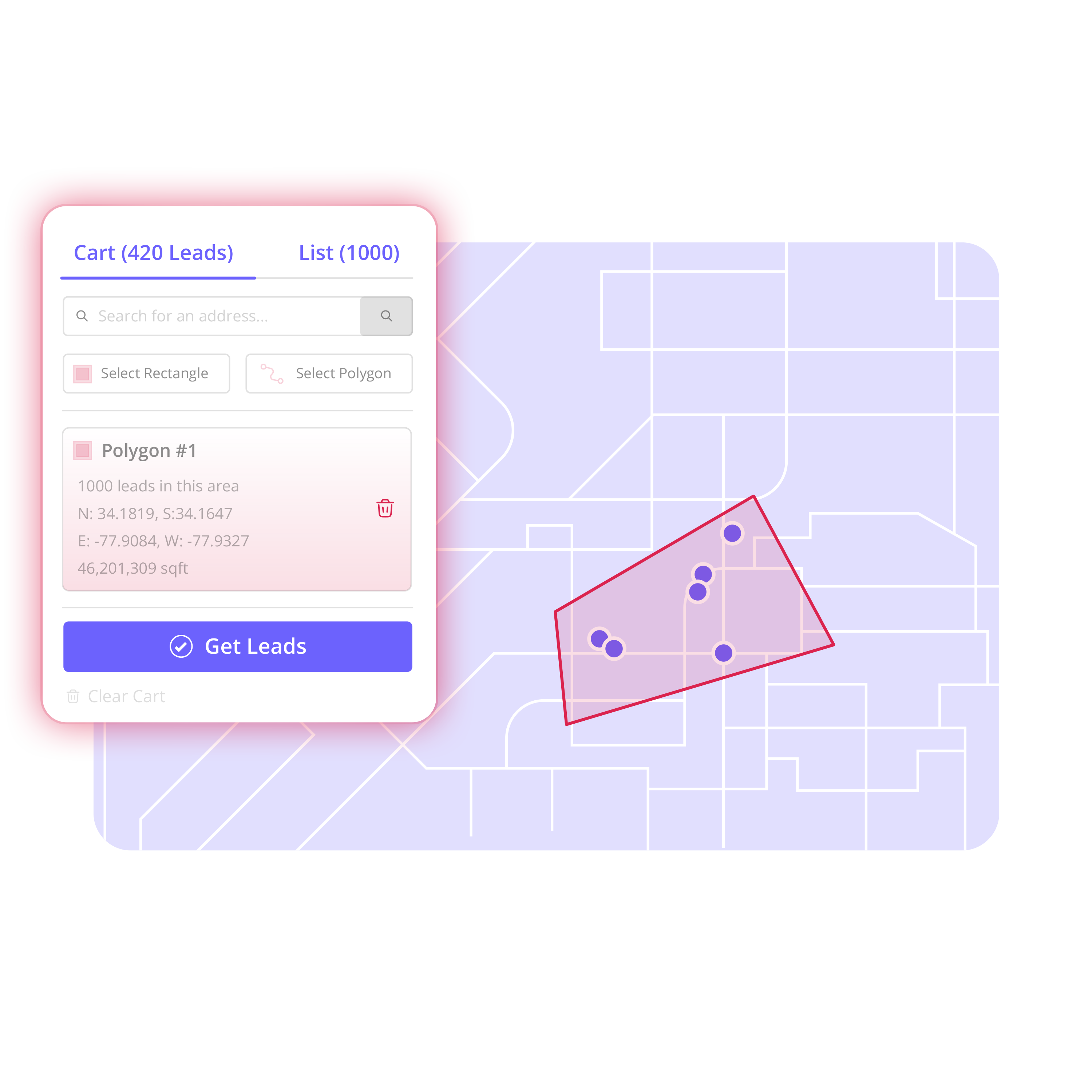
For roofing contractors, the clearest example is completed-job prospecting. Your crew finishes a roof. The sales manager locates the address, draws the streets the team wants to work, and selects the surrounding available properties. That selection becomes an organized Audience for door knocking, direct mail, calling, or a coordinated multi-channel campaign.
The same approach works when expanding into a new market. Choose the portion of town your team can realistically cover. Draw a rectangle or polygon around the area rather than relying on a broad ZIP code that includes streets you do not plan to work. Then build only the list that supports that campaign.
This is not about treating every property record as an active buyer. Available property or owner contact data does not indicate marketing consent or a request for service. It gives your team a starting point for lawful, responsible prospecting according to your outreach practices and applicable rules.
From Map to Prospect List: A Practical Workflow
The benefit of map prospecting is not simply seeing pins on a map. It is moving from geography to a usable campaign without rebuilding the list in several disconnected tools.
Start by choosing the area. Locate a completed job, a target subdivision, or an assigned sales territory. Draw the exact streets or boundaries your team intends to cover. This keeps the campaign tied to a real field plan instead of a vague market label.
Next, find and select the properties that fit the campaign. Map layers, clustering, and existing-contact overlays can help the team see where records are available and avoid blindly adding contacts already in the system. The objective is a clear working set, not the largest possible list.
Then create an Audience. An Audience gives the selected prospects a campaign home. Name it for the neighborhood, storm area, job site, rep, or outreach purpose so everyone understands what it is and why it exists. A label like "Oak Ridge - June Roof Install Surrounding Streets" creates far more clarity than a generic export file named "New Leads Final 2."
Build the territory first. Enrich what matters. Instead of paying attention to every available record at once, enrich selected prospects when the campaign calls for it. This helps control list-preparation work and keeps the team focused on the properties it actually plans to pursue.
Finally, organize execution. Assign prospects to the appropriate rep, set statuses, add notes, and use list or board views to keep ownership visible. Export the campaign-ready data into the sales or outreach tools your team already uses, or continue managing the prospecting work within the lightweight CRM workflow.
Territory follows this sequence: search the map, draw an area, select leads, create an Audience, enrich, organize, and export. Choose the area. Build the list.
The Operational Trade-Offs to Consider
The right choice depends on how your business generates business. A lead marketplace may be the better fit when you need inbound opportunities and have capacity to respond immediately. Map prospecting is usually the stronger fit when your team creates demand through geographic coverage and needs a repeatable way to prepare local campaigns.
Cost should be considered differently, too. Marketplace spend is usually tied to supplied leads or opportunities. Map prospecting is tied to building and working a territory your team chose. Neither approach removes the need for good follow-up, clear messaging, training, or management. The question is whether you want to buy individual opportunities, build a market around your own strategy, or use both.
Team structure also matters. A small owner-led roofing company may use a marketplace for occasional inbound demand while using map prospecting to keep reps productive around completed jobs. A larger canvassing team may prioritize map-based campaigns because managers need defined turf, fewer overlaps, and clean handoffs between reps.
Do not overlook data handling. Purchased lists, old spreadsheets, and separate exports often create duplicates, unclear ownership, and uncertainty about which records are already being worked. A map-first process gives the campaign a geographic boundary from the start. Existing-contact overlays, organized Audiences, assigned prospects, and activity notes make it easier to see what belongs to whom.
A Better Question Than “Which Source Is Best?”
The useful question is not whether map prospecting or lead marketplaces are universally better. Ask what must happen before your next rep starts outreach.
If the answer is, "We need someone who is actively looking for help," a marketplace may be part of the answer. If the answer is, "We know exactly where we want to sell, but building a clean list takes too long," map prospecting is the more direct path.
Strong local sales operations often use more than one source. They may handle inbound demand while also creating their own campaigns around jobs, neighborhoods, service areas, and expansion zones. The advantage is not relying on one vendor or one source to decide where the team works next.
Turn your last roofing job into your next neighborhood campaign. Start with a place your team can cover, define the territory clearly, and give every rep an organized list worth working.