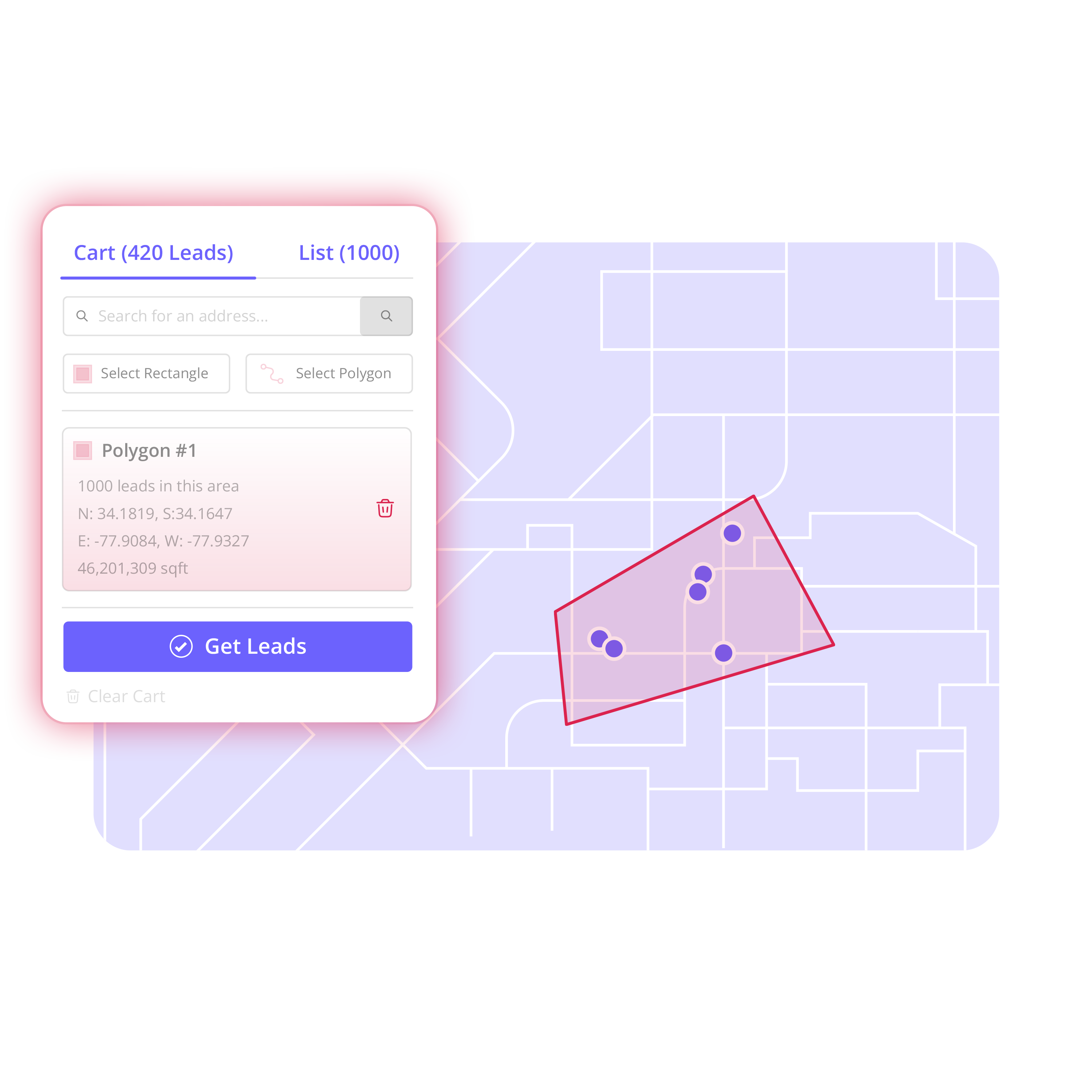

A ZIP code is rarely a real sales territory. It can include streets your team cannot reach, apartment blocks you do not serve, or neighborhoods already assigned to another rep. When you need to find properties inside custom boundaries, draw the area you actually plan to work, then turn only those records into a campaign list.
That approach gives roofing teams a clean target area around recent jobs. It lets solar canvassers work a defined set of blocks without crossing into another crew's turf. It helps investors focus an acquisition zone based on streets, parcels, or neighborhood edges instead of a broad postal boundary.
Choose the area. Build the list. Then put it to work.
Why custom boundaries beat broad location searches
Searching a city, ZIP code, or neighborhood is a useful starting point, but those boundaries are built for mailing and administration, not field execution. A service area may follow a highway. A canvassing route may stop at a commercial corridor. A storm-response campaign may need only the neighborhoods within a practical drive of an active job site.
Broad searches create cleanup work. Someone has to remove out-of-area records, identify overlap with existing campaigns, and explain where one representative should stop and another should start. That usually means multiple spreadsheets, inconsistent filters, and lists that are out of date as soon as they are shared.
A custom boundary makes the campaign definition visible. Your team can see the streets included, the properties selected, and the records assigned for outreach. That clarity matters when several reps prospect the same market or when managers need to decide whether an area is worth working.
How to find properties inside custom boundaries
The practical workflow is simple: start with the market, draw the workable area, review the properties, and create a list your team can act on. The important part is not drawing the shape. It is using that shape to make a clear campaign decision.
1. Choose a starting point
Search for an address, neighborhood, ZIP code, service area, or market where you intend to prospect. For a roofing contractor, that might be the streets surrounding a completed replacement project. For an HVAC company, it could be a neighborhood just beyond an established customer base. For an investor, it may be a group of blocks that match a defined acquisition strategy.
Starting with a recognizable place keeps the map useful. You are not hunting across an entire metro area. You are preparing a specific field campaign.
2. Draw the territory your team will actually work
Draw around the streets, subdivisions, or blocks that belong in the campaign. Follow natural field boundaries when possible: major roads, rail lines, commercial areas, community entrances, or the edge of your service radius.
Precision is useful, but it should serve the campaign. A territory that takes twenty minutes to explain is probably too complicated for a one-day canvassing push. On the other hand, a large expansion area may need a more detailed shape so your teams do not overlap.
Consider the operating reality before finalizing the boundary. Can a rep walk it in a shift? Does the area fit your direct-mail budget? Is it already covered by an active list? The right boundary depends on how the campaign will be worked, not just what looks clean on a map.
3. Review the properties in the shape
Once the boundary is set, identify the properties inside it and review what belongs in your list. This is where a map becomes a prospecting plan.
Do not assume every property should enter the campaign. A roofing team might exclude homes already tied to a current project, properties in a separate rep's territory, or addresses contacted recently. An investor may filter based on property characteristics that fit their criteria. A home-service company may remove locations outside the services being promoted.
The goal is a usable working list, not the biggest possible count. More records can mean more volume, but they can also create wasted door knocks, duplicate outreach, and unclear ownership.
4. Add selected properties to a campaign list
Move the records you intend to pursue into Contacts or a dedicated prospect list. Name the list so anyone on the team understands its purpose without opening the map. “Maple Ridge - Roof Replacement Surround” is more useful than “New Leads 4.”
At this point, the list should answer three basic questions: where is this campaign, why are these properties included, and who is responsible for working them? Clear names and statuses save time when a manager is reviewing several neighborhoods at once.
For larger teams, separate the master territory from individual rep assignments. You may draw one neighborhood-wide boundary, build the full property list, then assign sections or filtered records to specific people. That preserves a single view of the campaign while making ownership clear.
5. Enrich only the records that matter
Available homeowner and contact information can help teams prepare outreach, but enrichment should be selective. Start with the properties you have chosen to work rather than enriching a broad area you may never contact.
This keeps the list focused and reduces unnecessary data handling. It also gives managers a sensible order of operations: define the territory first, qualify the properties second, and add available information for the records that justify the effort.
Contact information is not permission to contact someone. Your team still needs to follow applicable calling, texting, email, direct-mail, and privacy requirements, along with your company’s own policies. A clean list supports better execution; it does not replace responsible outreach practices.
6. Organize before you export
Before sending the campaign to your CRM, canvassing platform, dialer, or mail provider, organize the records for the next action. Use tags, filters, statuses, boards, or assignments to separate prospects by territory, campaign type, owner, and stage.
For example, a solar manager may tag a list by neighborhood and assign a status such as “Route Ready.” A roofing sales manager may use tags for “Near Active Job,” “Door Knock,” and “Direct Mail” so the same territory can support more than one outreach motion without mixing the work.
Organization is what prevents a good map search from becoming another disconnected spreadsheet. When reps can filter their own assigned properties and managers can see the campaign at a glance, follow-up becomes easier to manage.
7. Export a clean list into the tools you already use
Export the records when the list is ready for the next system. Territory by Top Interaction is designed to be the campaign-list creation layer between your map and the sales process already in place. Build the geographic list, organize it for the campaign, and export a clean CSV for the tools your team uses.
That may mean a CRM for call tracking, a canvassing app for field routes, a direct-mail provider for postcards, or an internal workflow for assignment and follow-up. You do not need to rebuild your whole sales stack to gain better control over where you prospect.
Common boundary mistakes that create bad lists
The most common mistake is treating map coverage as campaign readiness. A large polygon can look productive while hiding a practical problem: the team does not have the time, budget, or ownership structure to work it.
Another mistake is redrawing nearly identical areas for every campaign. If a neighborhood is a recurring market, keep a consistent territory definition and use lists, tags, and statuses to distinguish each campaign. This makes it easier to avoid duplicate records and compare activity across the same area over time.
Teams also lose time by exporting too early. A raw property pull is not yet an outreach list. Review the records, remove known exclusions, establish ownership, and decide what information is needed before handing the file to the next team or platform.
Finally, do not confuse a custom boundary with a permanent restriction. Markets change. A storm event, a new job site, an expanded service crew, or a shift in acquisition criteria may justify a new shape. The value is having the control to redraw the area when the plan changes.
Make the map accountable to the campaign
A drawn territory should lead to an action: a route, a call list, a direct-mail audience, an assigned board, or a clear decision not to work the area. If it does not, it is just a shape on a map.
Set the boundary around the work your team can own this week. Build only the list that supports that work. The result is less cleanup, fewer overlapping efforts, and a clearer path from a local opportunity to the next prospecting action.