
A productive solar canvassing day starts before the first knock. To create solar door knocking routes that your team can actually work, define the streets, build the property list, set clear ownership, and give each rep a logical starting point. The goal is not a random collection of addresses. It is a focused neighborhood campaign your team can cover without duplicate visits, missed blocks, or morning spreadsheet cleanup.
A route is more than a driving path. For solar sales teams, it is a defined group of streets, properties, and assignments that turns a local market into organized field activity. Choose the area. Build the list. Then decide how your team will work it.
Start with the neighborhood, not a generic list
Solar canvassing works best when the territory has a reason behind it. You may be expanding from a recent installation, working a neighborhood where your team has active referrals, or concentrating activity around a local event or campaign. Whatever the reason, start with a visible area on a map.
Generic homeowner lists can create unnecessary work. They may include properties outside your actual coverage zone, duplicate records you already own, or addresses that force reps to spend half the day driving between disconnected streets. A defined neighborhood gives the team a practical boundary and makes it easier to see what has been worked.
Choose an area that is compact enough to cover well. A new rep may need a few adjacent blocks and a clear starting corner. An experienced team can take a larger subdivision or several connected streets. The right size depends on housing density, walking conditions, team capacity, local rules, and how much time the team has in the field.
Do not confuse a prospecting territory with a route optimizer. Your crew may still use its preferred navigation tools to travel between areas. The immediate job is to build a clean, workable territory first, then organize the list so each canvasser knows where to begin and what they own.
How to create solar door knocking routes in six steps
1. Choose the campaign area
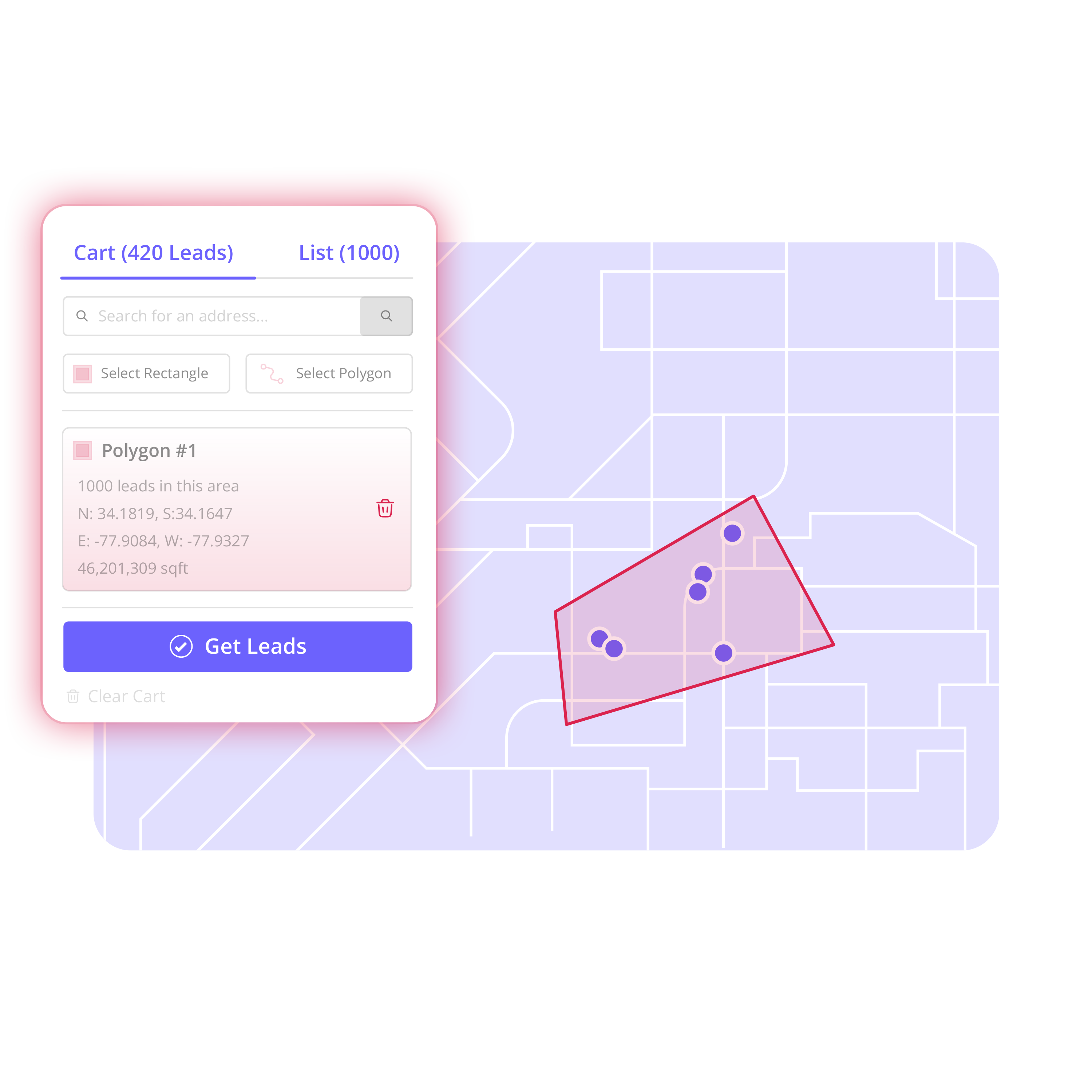
Open the map and search for the neighborhood, subdivision, or nearby installation that will anchor the campaign. Then draw the exact streets your team wants to prospect. A rectangle can work for a simple block pattern. A polygon is better when the neighborhood has irregular edges, divided roads, commercial sections, ponds, or streets you do not want included.
Be deliberate about boundaries. Major roads, gated entrances, apartment complexes, and nonresidential parcels can interrupt an otherwise simple route. If those areas do not fit the campaign, leave them out from the start. That decision is faster than cleaning the list after it reaches the field.
2. Find the properties inside the boundary
Once the territory is drawn, review the available property records within it. The map view helps you see whether the campaign is one connected walkable area or a collection of disconnected pockets. Clustering can help when the territory contains many properties, while a closer map view helps managers spot gaps and boundary mistakes.
At this stage, think in terms of coverage. Are there streets with dense groups of single-family homes? Is one section already assigned to another rep? Are there existing contacts your company has worked before? Existing-contact overlays can help prevent the common mistake of treating every address as brand new.
Solar teams often want to add local context before selecting records. For example, a manager may separate a core subdivision from a neighboring section with a different housing layout. There is no single ideal route shape. The best route is the one your team can clearly explain, assign, and complete.
3. Select properties and build an Audience
Select the records that fit the campaign, then create an Audience. An Audience is the working prospect list for that specific territory. Give it a useful name that makes ownership and purpose obvious, such as “Maple Ridge Solar Canvass - North Section” or “Westfield Installation Follow-Up - Week 1.”
Naming matters when several campaigns are active. “Solar leads October” tells a manager very little. A name tied to a neighborhood, section, and campaign period lets the team find the right list quickly and reduces accidental overlap.
This is where solar route planning becomes operational instead of theoretical. Your map selection becomes a defined list that can be reviewed, assigned, and moved into outreach. Territory by Top Interaction is built for this map-to-prospect-list workflow: search the map, draw an area, select leads, and create an Audience before your team starts working the doors.
4. Enrich only the records that matter
Not every record needs the same level of research. Build the territory first. Enrich what matters.
A team preparing for door knocking may initially need property addresses and internal campaign organization. Before a manager assigns follow-up calls, direct mail, or additional outreach, they may choose to enrich selected records with available homeowner or property-owner contact information. That keeps enrichment focused on the properties the team has chosen to pursue instead of adding cost and clutter to a broad, unfiltered list.
Available contact information is not permission to contact someone through every channel. Your team should follow applicable laws, company policies, and outreach rules for calls, texts, email, and door-to-door activity. Keep the campaign purpose clear and use data responsibly.
5. Split the territory into clear rep assignments
A route only works when ownership is obvious. Divide the Audience by natural street groups, entrances, or sections that a rep can cover without crossing another rep's path. Assign prospects to the appropriate canvasser or organize them by status in a board or list view.
Avoid splitting a single short street between two people unless there is a strong reason. It creates confusion at the doors and makes progress harder to evaluate. Instead, give each rep a compact section with clear edges: one side of the subdivision, a set of cul-de-sacs, or a group of connected blocks.
Use notes to capture field instructions that do not belong in a map boundary. A manager might note the launch point, a time window, nearby active installations, a local access issue, or the rep responsible for revisits. Statuses then help distinguish untouched prospects from completed conversations, follow-up opportunities, no-answer visits, and records that should not be worked again.
6. Export the campaign or work it from the list
Once the Audience is organized, decide how the team will use it. Some teams continue managing assignments, notes, activities, and statuses in the list. Others export the campaign-ready data into the sales or outreach tools they already use.
Export only after the territory is cleaned and assignments are clear. Sending an unfiltered file to the field recreates the problem you were trying to solve: reps sorting addresses, guessing boundaries, and working records that should have been excluded. A clean export should reflect the campaign your manager approved, not every property returned by a broad search.
Build routes for coverage, not just volume
The biggest route-planning mistake is measuring success by the number of addresses added. A list of 800 disconnected properties may look productive, but it can be harder to execute than 250 well-defined homes on connected streets. Dense, walkable coverage usually makes it easier for managers to coach, reassign, and review field progress.
That does not mean every campaign should be small. A multi-rep solar push may need several Audiences within one larger neighborhood. Create a parent naming convention, then break the campaign into sections that match the number of canvassers and available field time. For example, one subdivision can become North, Central, and South Audiences rather than one oversized list with unclear ownership.
The best division depends on your team. If reps work independently, compact areas reduce overlap and simplify accountability. If teams work in pairs, assignments may be larger but should still have obvious boundaries. If weather, daylight, or local restrictions limit time at the doors, start with the highest-priority section instead of trying to cover the entire area at once.
Keep the route usable after the first day
A solar door knocking route should improve as the team works it. Update statuses promptly. Add notes that help the next conversation. Reassign streets when staffing changes. Remove records that should not remain in active rotation. These small operational habits prevent a good territory from turning into an unreliable list by the end of the week.
Managers should also review completed activity against the map. If one section remains untouched while another has multiple visits, the problem may be assignment clarity rather than rep effort. If two Audiences overlap, adjust the boundary before the next shift. Map-first planning makes these issues visible early.
For solar teams, the practical advantage is control. You choose where to canvass, see the properties within that area, and turn the territory into an organized prospecting campaign without starting from a raw spreadsheet. Start with one neighborhood your team already understands. Draw the streets, build the list, assign the work, and let the next route be easier than the last.