
A rep starts at a street where your company just completed a roof, a solar install, or an HVAC replacement. Two blocks later, they are knocking doors that were already worked last week because nobody can see the prior activity. That is not a rep problem. It is a canvassing route planning problem.
Good canvassing route planning does more than draw a line between doors. It gives each rep a defined area, a usable property list, and a clear record of what happened there. The result is less overlap, less time spent sorting raw addresses, and a campaign your team can actually manage from first knock through follow-up.
Start with the territory, not the route
The fastest-looking route is not always the most productive one. A routing tool can tell a rep how to move efficiently from one address to the next, but it cannot decide which homes belong in the campaign, where one rep's responsibility ends, or which properties deserve attention first.
Start by choosing the geographic opportunity. For a roofing company, that may be the streets around a recent installation or a neighborhood affected by a storm. A solar team may focus on a subdivision with the right home types and no active rep assignment. An HVAC company may choose a service-area pocket where it wants more maintenance agreements. Investors may define a specific acquisition zone rather than work an entire ZIP code.
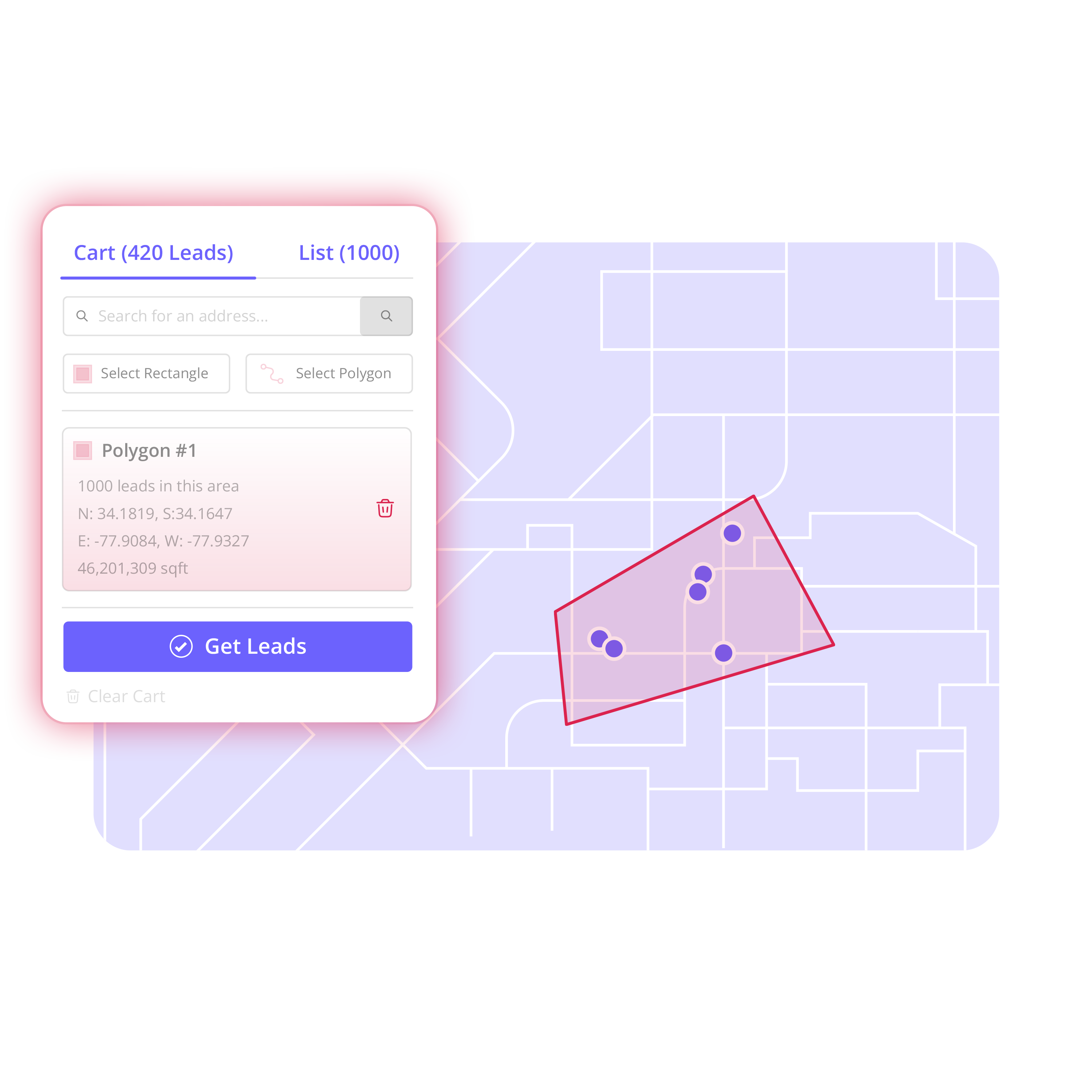
Draw the exact streets or neighborhood your team wants to prospect. Avoid vague instructions such as "work north of Main Street" when a boundary can be shown on a map. A visible territory removes interpretation. Reps know where to work, managers know what was assigned, and adjacent teams can avoid stepping on each other.
Territory by Top Interaction is built around this order of operations: choose the area, find the properties, build the list, enrich what matters, organize, and export. That matters because the route should come from a deliberate campaign list, not from whatever addresses happened to be available first.
Build a route from a campaign-ready list
Once the boundary is set, find the properties inside it and turn them into a working list. This is where many teams lose time. They pull a broad list, clean it in a spreadsheet, try to remove addresses outside the real target area, then discover duplicates or missing notes after reps have already started working.
Build the list from the properties within the chosen territory. Then decide which records belong in the campaign. Not every address inside a boundary needs to be included. A roofing team might exclude homes already marked as contacted, current customers, or unsuitable property types. A canvassing manager may hold back part of an area for a second rep or a later shift.
Use filters, tags, statuses, and assigned lists to make the list operational. A property is not useful merely because it appears on a map. Your team needs to know whether it is unworked, attempted, contacted, qualified, not interested, or ready for follow-up.
This separation is useful: the territory defines where you are allowed to work; the campaign list defines which properties you intend to work; the route defines the order a rep works them. When those three things get blended together, teams create confusion that looks like poor field execution.
Enrich selectively
Available homeowner and contact information can help a team prioritize or support outreach, but it should be added only to records the team actually plans to pursue. Selective enrichment keeps the campaign focused and avoids paying attention to data that will not be used.
It also supports better preparation. A manager can build the target list first, enrich selected records as needed, and export clean data into the CRM, canvassing platform, dialer, or direct-mail process already in place. Available contact information does not create permission to contact someone. Your outreach still needs to follow applicable laws, company policy, and channel-specific rules.
Use canvassing route planning to reduce field friction
A route should be easy to follow at the curb. If a rep has to zoom across a map, search multiple tabs, and ask who owns a street, the plan is not ready.
For a door-knocking campaign, organize the day into manageable sections. One rep may receive the east side of a neighborhood while another works the west side. A larger development may be divided by natural break points such as entrance roads, busy intersections, cul-de-sacs, or phases of construction. The goal is not to create perfectly equal geometry. The goal is to create clear, workable ownership.
A practical route plan accounts for field conditions that a map alone cannot see. Gates, long driveways, apartment access, school traffic, weather, daylight, and local solicitation rules can change what a rep can realistically cover. It depends on the market, the team, and the purpose of the campaign.
For example, a storm-response roofing campaign may prioritize the streets closest to visible damage or recent job sites, even if that order adds a few minutes of driving. A solar team working a dense subdivision may prioritize continuous blocks to preserve momentum and make it easier to track coverage. An HVAC team might build smaller canvassing sections around technician appointments so field reps can follow up near existing service calls.
The right route is usually the one that makes the next action obvious. Reps should know where to begin, which addresses are in their assignment, how to record an outcome, and what happens after a positive conversation.
Assign ownership before the first door is knocked
Overlapping reps create more than wasted effort. They create conflicting notes, repeated visits, frustrated homeowners, and unreliable reporting. Clear territory ownership prevents most of that before the campaign begins.
Assign the list or territory to a specific rep, crew, or manager. Label it with the campaign name, date range, market, and purpose. Keep the naming simple enough that someone can understand it at a glance: "Cedar Ridge - Roof Replacement Radius - Week 2" is more useful than "New List Final v4."
Managers should also decide how reassignment works. If a rep does not finish an area, does the remaining list stay with that rep, return to the manager, or move to the next shift? If a homeowner asks for a callback, who owns the follow-up? Those decisions should be made before the list goes live, not after two people claim the same opportunity.
A clean process also protects reporting. When every record has a territory, list, status, and owner, managers can see activity without reconstructing the campaign from text messages and disconnected spreadsheets.
Give reps enough structure, not too much
There is a trade-off in every canvassing plan. Too little structure leaves reps wandering and creates uneven coverage. Too much structure can make them ignore real-time signals in the field.
Set the non-negotiables: the boundaries, assigned records, required statuses, and follow-up rules. Then give reps room to make sensible decisions. If a homeowner points them to several interested neighbors, a rep should be able to work that immediate opportunity without losing the campaign's structure. The activity still needs to be recorded so the team can see what changed.
Do not confuse a large list with a productive shift. A list that is too long encourages rushed conversations and weak documentation. A list that is too short can leave reps idle or force them into unassigned areas. Use past field results to adjust the size of sections, but keep the boundary and ownership clear.
Plan for follow-up while building the route
Canvassing does not end at the door. A route plan should make it easy to separate immediate opportunities from future work. Use statuses and tags for outcomes such as no answer, revisit, requested information, appointment set, or do not contact according to your company policy.
That organization matters when the field day ends. The manager should be able to export a clean list for the next system in the process, whether that is a CRM, an appointment-setting workflow, a direct-mail campaign, or a follow-up call list. The original territory remains visible, so the team can return to the same area without rebuilding the campaign from scratch.
Review coverage, then improve the next route
After a shift, review what was actually worked against what was assigned. Look for unvisited clusters, duplicate attempts, records without outcomes, and streets that produced stronger conversations. This is not about blaming reps for every unfinished door. It is about finding where the plan did not match field reality.
If one route regularly goes unfinished, split it differently. If reps spend too much time driving between scattered addresses, tighten the campaign boundary or group the list by contiguous blocks. If a recent job site produces better conversations on nearby streets, build that pattern into the next campaign.
The best canvassing route planning is repeatable, not rigid. Choose the area with purpose. Build a clean list. Assign ownership. Give reps a route they can follow. Then use the results to make the next territory easier to work.
When your team can move from a defined neighborhood to a clear list and a named owner without spreadsheet cleanup, the map stops being a reference point. It becomes the starting point for work your reps can carry out.