
A storm report may tell you where to look. It does not tell your team exactly which streets to work, which properties belong in the campaign, or who owns the next action. To build storm area audiences that are usable in the field, start with a defined territory and turn it into an organized prospect list.
For roofing teams, speed matters after a storm. But rushing into a broad ZIP code list creates familiar problems: homes outside the area your team can realistically cover, duplicate records, unclear rep ownership, and too much cleanup before anyone can knock, call, or mail. A better process is simple: choose the area, build the list, enrich only what matters, and give the campaign a clear owner.
Start with the neighborhood, not the whole storm zone
A reported storm path can cover a large area. Your team should not treat all of it as one campaign by default. The right starting point depends on your capacity, current jobs, crew availability, and how your sales operation works.
If you just completed a roofing job in a storm-affected neighborhood, that job can be the center of the next campaign. Locate the address on the map and inspect the surrounding streets. If you have canvassers working a defined section of town, draw the area they can cover without overlapping another team. If you are expanding into a new market, begin with a manageable neighborhood rather than an entire city.
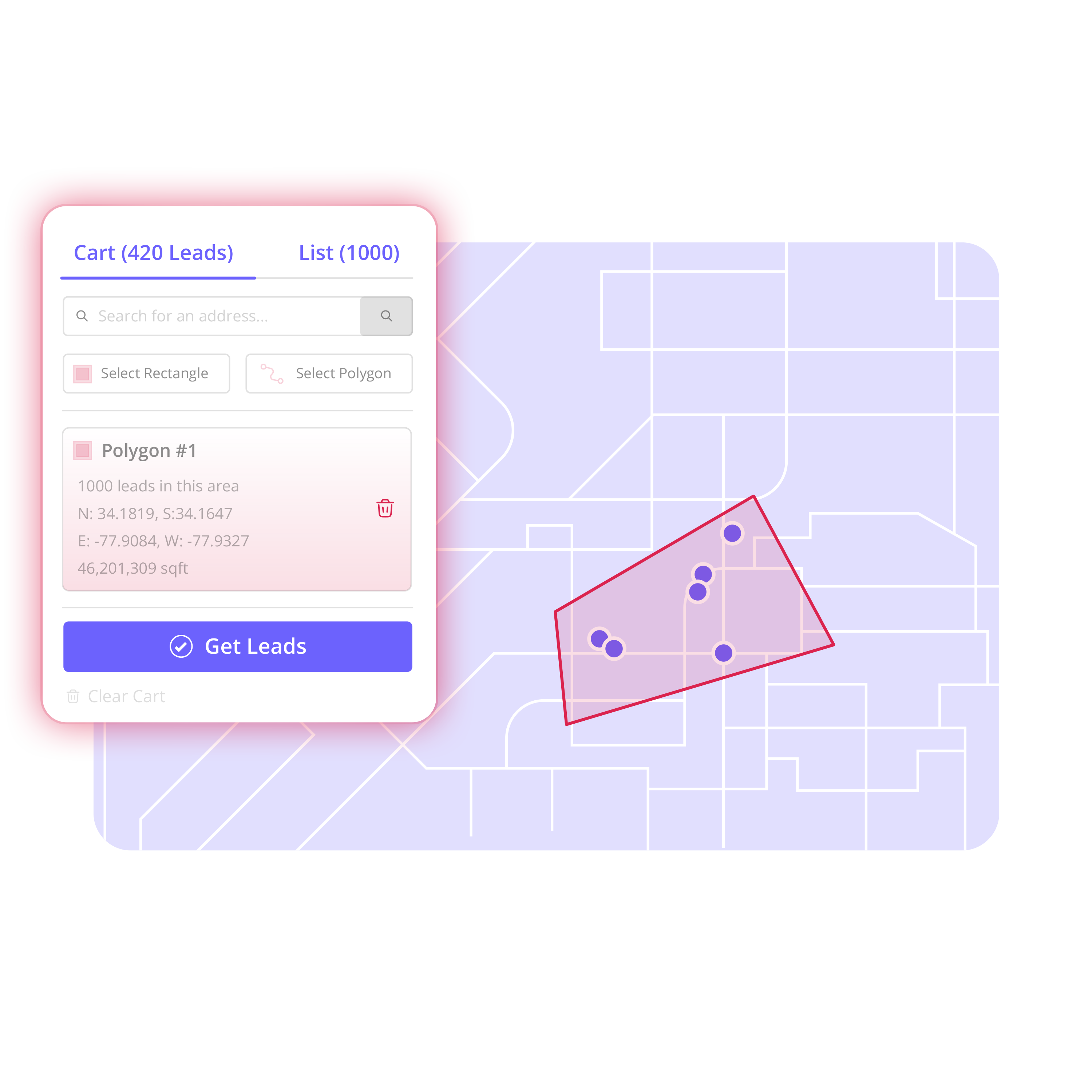
This is where geographic control matters. A rectangle may work when the streets are laid out in a clean grid. A polygon is better when you need to follow subdivisions, major roads, service boundaries, or a specific cluster of homes. The goal is not to create the largest possible audience. It is to create an area your team can actually work.
A storm map is a signal. Your territory is the decision.
How to build storm area audiences from a map
The practical workflow is from map to prospect list. In Territory, search for the location you want to work, draw the exact area, review the available properties, and select the records that belong in your campaign. You are choosing the streets first instead of trying to force a generic list to fit your strategy later.
1. Choose a workable campaign boundary
Begin with one clear reason for the area. Maybe it surrounds a recent roofing job. Maybe it is a subdivision where a storm event was reported. Maybe it is a set of streets your team has already started canvassing.
Draw a boundary that makes operational sense. Keep natural breaks in mind: highways, commercial corridors, neighborhoods with restricted access, and areas assigned to another rep. A tightly defined boundary helps sales managers avoid the vague instruction of “work the storm area” and replace it with a specific campaign footprint.
For a small team, a few adjacent blocks may be the right size. For a larger operation running multiple crews, separate the wider affected area into distinct audiences. Each audience can have its own owner, status, notes, and export, without mixing every prospect into one oversized list.
2. Find and select the properties that fit
Once the area is drawn, review the available property records inside it. This is the point where a map-based process saves time over buying a broad list and manually sorting addresses afterward.
Selection should match the purpose of the campaign. A roofing company may focus on residential properties around a completed replacement job. A restoration company may define a compact affected neighborhood for outbound outreach. A property management company may identify properties in a target acquisition or service zone.
Do not assume every property in a storm area is equally relevant. Some may already be customers or existing contacts. Others may sit outside the practical reach of your field team, even if they fall inside the original boundary. Use existing-contact overlays and record review to avoid creating unnecessary duplicates and to see where your organization already has a relationship.
The audience is not just a collection of addresses. It is the working list for a specific sales effort.
3. Create an audience with a clear operating name
Give the audience a name that tells your team what it is and why it exists. “Northside Storm” is vague once several campaigns are underway. “Oak Ridge - May Hail - Job Area” or “Westfield - Storm Response - Rep Team A” gives managers and reps useful context immediately.
A good name should identify the location, campaign purpose, and, when helpful, the time period or owner. Consistent naming keeps List View, Board View, exports, and team discussions easier to manage.
It also makes future decisions simpler. If a manager asks which homes were selected around a completed job, the answer should be an audience with a defined boundary, not an old spreadsheet with unclear filters.
4. Build the territory first. Enrich what matters.
Contact enrichment is useful when it supports a real next step. It is not a reason to enrich every property record the moment a storm occurs.
After you build the audience, decide which records are worth enriching based on your campaign plan. You may want contact details for the properties assigned to a calling team, for owners selected for direct outreach, or for the addresses a rep could not reach in person. Selective enrichment keeps the campaign focused and reduces unnecessary data handling.
Available contact information should be used responsibly and in line with applicable outreach rules and your company’s policies. A phone number or email address being available does not mean the property owner requested contact or consented to a particular marketing channel.
This sequence is the practical one: define the geography, select the properties, then add available contact information to the records you intend to pursue. Build the territory first. Enrich what matters.
Organize storm campaigns before the field work begins
A clean audience still needs ownership. Before exporting or assigning field work, decide how the campaign will move through your operation.
For a canvassing team, assign groups of prospects to individual reps or team leads. For an outbound team, organize contacts by calling status and follow-up stage. For a mixed campaign, keep notes on property observations, prior contact attempts, referrals, and job-site context. The best structure depends on whether your team is knocking doors, making calls, coordinating direct mail, or using several channels together.
Status discipline matters here. If a record has been assigned, contacted, revisited, or removed from the campaign, update it. That prevents two reps from working the same property and gives managers a clearer view of what remains. Lightweight CRM tools such as contact profiles, statuses, assignees, notes, and activity are most useful when they reduce confusion, not when they create extra administrative work.
For storm response, create separate audiences when the work is meaningfully different. A neighborhood around an active job may need immediate field coverage. A larger surrounding area may be better suited for later outbound follow-up. Keeping those efforts separate gives each one a clearer owner and avoids turning one storm event into an unmanageable master list.
Export a list your team can actually use
Some teams will work the campaign inside their prospecting workflow. Others need a CSV for the sales, outreach, or reporting tools they already use. Either way, export only after the list is organized enough to be useful.
Before exporting, check the basics: the audience has a clear name, selected records belong in the intended geography, existing contacts are handled appropriately, assigned reps are visible, and the fields match the purpose of the campaign. A door-knocking sheet may need different information than a calling list or a direct-mail file.
This final review is where many teams avoid a costly time drain. It is easier to fix territory boundaries and ownership on a map than after a spreadsheet has been passed across sales, operations, and marketing.
Common mistakes when building storm audiences
The biggest mistake is treating every storm-affected address as one campaign. Broad lists feel productive at first, but they usually leave your team with too many properties, too little context, and unclear priorities.
Another mistake is enriching before deciding who will work the list. That adds effort before the campaign has a defined purpose. The third is failing to separate active-job areas from wider market coverage. Those areas may sit near each other, but they often need different timing, messaging, and ownership.
Keep the process grounded in field reality. If a rep cannot explain where their territory begins and ends, the campaign is not ready. If a manager cannot see who owns the next action, the list is not organized enough.
A storm creates urgency, but it does not require chaos. Start with the neighborhood you can work well, draw the boundary your team understands, and turn that territory into an organized prospecting campaign. Choose the area. Build the list.