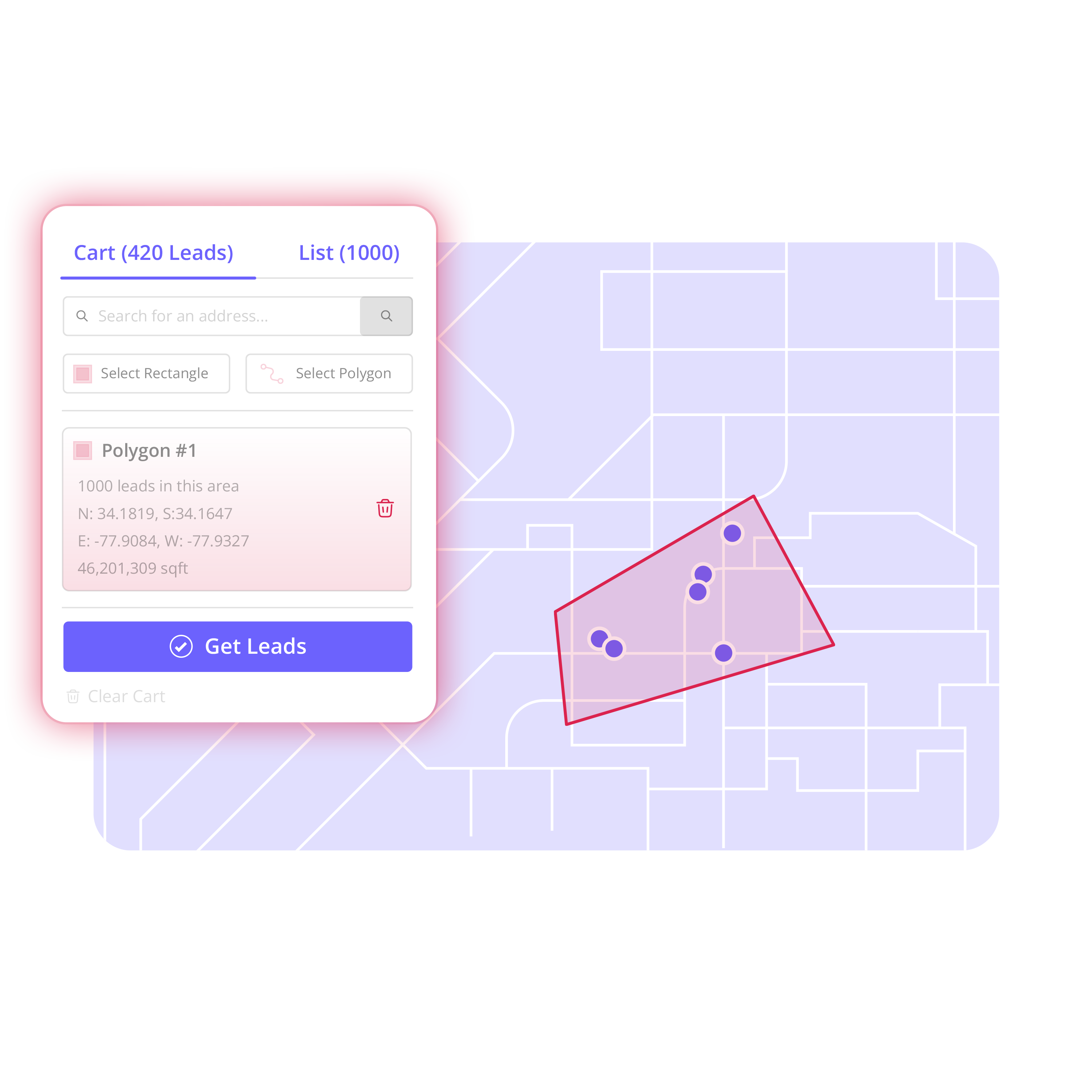

A territory is only useful when your team knows exactly who to work inside it. Effective territory management turns a neighborhood, service area, storm zone, or acquisition market into a clear prospecting plan: defined boundaries, usable property records, assigned ownership, and a list ready for outreach.
For roofing, solar, HVAC, real estate, and other local sales teams, the problem is rarely a lack of places to sell. The problem is turning a map into organized work without handing reps a vague ZIP code, a generic purchased list, or a spreadsheet full of duplicates. Choose the area. Build the list. Give the team a clear next move.
What territory management should accomplish
Territory management is the process of defining where your team will prospect, deciding which records belong in that campaign, and controlling how those records move into outreach. It is part geographic planning, part list building, and part sales operations.
A well-run territory answers practical questions before the campaign starts. Which streets are included? Which rep owns them? Are nearby job sites part of the plan? Have these properties already been contacted? Is the list complete enough for canvassing, direct mail, calling, or a combination of channels?
That clarity matters because geographic campaigns become expensive when the setup is loose. Reps overlap. A canvassing team wastes time walking streets outside the target area. Marketing sends mail to records sales has already worked. Managers cannot tell whether a territory has been covered or simply talked about.
The goal is not to create the biggest list possible. It is to create a list your team can actually use.
Start with the opportunity, not a generic lead file
The strongest territories begin with a reason to prospect a specific place. A roofer may want to work the blocks around a recent installation. A solar team may focus on a neighborhood with homes that fit its ideal project profile. An HVAC company may expand from an existing service cluster. An investor may draw an acquisition zone around a target submarket.
Starting with the area gives the team control. Instead of buying a broad list and trying to sort out who is relevant later, you define the geographic opportunity first and build from there.
This approach is especially useful when boundaries do not follow neat ZIP codes. A ZIP code can cross different housing types, school districts, municipalities, and service priorities. It may include streets your team cannot efficiently cover or exclude the few blocks that matter most.
Choose boundaries your field team can work
A practical territory should match how people move and sell in the field. Draw the exact streets, neighborhood, service radius, or custom shape your team wants to cover. Use natural boundaries when they help, such as major roads, subdivisions, or municipal lines.
Precision has a trade-off. A very tight territory gives reps a focused route and a cleaner campaign, but it may not produce enough records for the planned effort. A broader area creates more volume, but can dilute the campaign and make ownership harder to manage. The right size depends on the channel, available team capacity, and the reason the territory was chosen.
For example, a canvassing crew working around a roofing job may need a compact, walkable set of streets. A direct-mail campaign can reasonably cover a larger service area. An acquisitions manager may draw a broad market first, then filter the records into smaller working zones.
Build the property list before adding contact data
Once the boundary is set, find the properties inside it and build the campaign list. This is where many teams lose time. They pull data from several sources, reconcile addresses in a spreadsheet, delete records that fall outside the area, and still cannot tell which rows belong to the actual campaign.
A better workflow keeps the map and the list connected. Search an address, neighborhood, ZIP code, service area, or market. Draw the territory. Find the properties within that boundary. Then add the records your team intends to pursue.
Do not assume every property inside a shape belongs on the list. Review the records against the campaign goal. A home-service company may exclude commercial properties. A solar team may separate smaller homes from larger target homes. An investor may focus on a particular property type or ownership profile. Territory management works best when the boundary establishes the universe and your selection process determines the campaign.
This is also the point to prevent duplicate effort. Before assigning records, check whether properties are already on another active list, tied to an existing opportunity, or marked as contacted. A clean list protects the customer experience and gives managers a more accurate view of coverage.
Enrich selected records, not everything on the map
Available homeowner and contact information can help a team prepare outreach, but enrichment should follow selection, not replace it. Add available information to the properties your team has chosen to work instead of enriching a large area before you know whether those records fit the campaign.
That order keeps costs and cleanup under control. It also helps teams stay intentional about their outreach process. Available contact information is not permission to contact someone. Your organization still needs to follow applicable laws, internal policies, and channel-specific requirements for calling, texting, email, direct mail, or door-to-door activity.
For field teams, property details may be enough to start. A rep can see the address, place it on a route, and record outcomes after a visit. For a more coordinated campaign, selected records can be enriched and prepared for the outreach tools your team already uses.
The operating principle is simple: enrich what matters. Do not create more data than the campaign can absorb.
Organize territory ownership before outreach begins
A list without ownership is a source of confusion. Every active territory should have a named owner, a clear status, and an agreed next action. That could be a sales rep, a canvassing manager, an acquisitions specialist, or a shared team queue.
Use lists, tags, filters, statuses, and boards to make the campaign visible. Label the source or reason for the territory, such as “Storm response - Northside,” “Job-site saturation,” “Spring HVAC expansion,” or “Q3 acquisition zone.” Track where records sit in the process, whether they are unworked, attempted, contacted, qualified, or closed out.
Clear labels make it easier to answer operational questions without rebuilding the list every week. Which territories are active? Which rep has not started? Which streets are complete? Which records need a second attempt? Where is overlap occurring?
Assign by geography when geography drives execution
Some teams assign records round-robin, and that can work for inbound lead flow. Geographic prospecting is different. When reps own defined blocks or neighborhoods, they can build familiarity, reduce drive time, and avoid stepping on each other’s work.
Still, geographic assignment is not always the best answer. A smaller team may need one shared territory so it can shift capacity quickly. A storm-response operation may assign areas by availability rather than permanent ownership. The important part is that the rule is visible and consistent.
If a territory changes hands, update the assignment and status before the new person begins. That one habit prevents the familiar problem of two reps believing the same property is theirs.
Export clean lists into the tools you already use
Territory management should not force a team to replace its CRM, canvassing platform, direct-mail provider, or sales process. Its job is to prepare the geographic campaign and hand off a clean list.
Once the records are selected, enriched where appropriate, organized, and assigned, export the CSV for the next step. Send it to the CRM for tracking, a canvassing tool for field execution, a mailing workflow for print preparation, or an internal operations process.
The export should reflect the campaign as it actually exists, not a raw dump that requires another round of spreadsheet cleanup. Include the fields the next system needs, keep internal tags when they help with reporting, and avoid sending records that are not ready for action.
Territory by Top Interaction fits this workflow as the campaign-list creation layer between the map and the sales tools your team already relies on. Draw the area, identify properties, build the list, organize ownership, and export when the campaign is ready.
A practical example: roofing around a recent job
A roofing company completes a visible project in a neighborhood and wants to canvass nearby homes while the job is still fresh in local view. The manager draws the streets around the installation instead of assigning the rep an entire ZIP code. The team identifies properties within that area, reviews the list, and removes records already being worked by another rep.
Next, the manager creates a campaign list, marks it as job-site saturation, assigns it to the local rep, and sets the starting status to unworked. If the company wants to add available homeowner or contact information for follow-up, it enriches only the selected records. The rep receives a clear route and ownership. Operations can see progress. The company exports the final list into the system used to record outcomes.
That is territory management in practice: less time assembling data, fewer questions in the field, and a campaign built around a real geographic opportunity.
Your next territory does not need a bigger spreadsheet. It needs a defined boundary, a purposeful list, and one clear owner ready to work it.