
A roofing crew finishes a visible project on a street with 200 nearby homes. A solar team sees a neighborhood where recent installs have created social proof. An HVAC company wants to expand into a service pocket without sending reps across town. The opportunity is geographic, but turning it into a usable campaign is where neighborhood prospecting often breaks down.
Teams know where they want to work. What they need is a clean way to define that area, identify the properties inside it, decide which records matter, and hand a clear list to the people responsible for outreach. Choose the area. Build the list. Then put it to work.
Why neighborhood prospecting gets messy
Most local sales teams do not have a shortage of places to prospect. They have a shortage of clear, usable campaign lists.
A manager may point to a completed job, a storm-affected area, or a target subdivision and tell the team to work nearby. The next steps are usually improvised: someone searches maps, copies addresses into a spreadsheet, buys a broad list by ZIP code, or assigns vague boundaries such as “everything east of Main Street.” By the time the list is ready, it may include duplicates, properties outside the intended area, records with no owner assigned, and columns that no one needs.
That creates predictable field problems. Two reps knock the same street. A canvasser works outside the assigned area. The direct-mail list includes commercial parcels or homes the team did not intend to target. Sales managers cannot tell what has been worked and what remains.
The issue is not effort. It is that the campaign starts with raw geography but has no repeatable process for becoming an organized prospect list.
Start with territory, not a generic list
The strongest neighborhood campaigns begin with a specific reason to work a specific area. That reason might be proximity to a recent roof replacement, a cluster of aging homes, a storm path, an expansion market, or a defined acquisition zone.
Starting with geography gives the team control. Instead of accepting every record in a broad purchased list, you decide which streets, blocks, or property clusters belong in the campaign. That matters when a boundary follows a highway, a school zone, a subdivision entrance, or a service-area edge that a ZIP code cannot describe accurately.
A ZIP code can be useful for market research or large campaigns. It is less useful when the real target is 14 streets surrounding an active job site. Neighborhood prospecting works best when the territory matches the field plan.
Draw the area your team will actually work
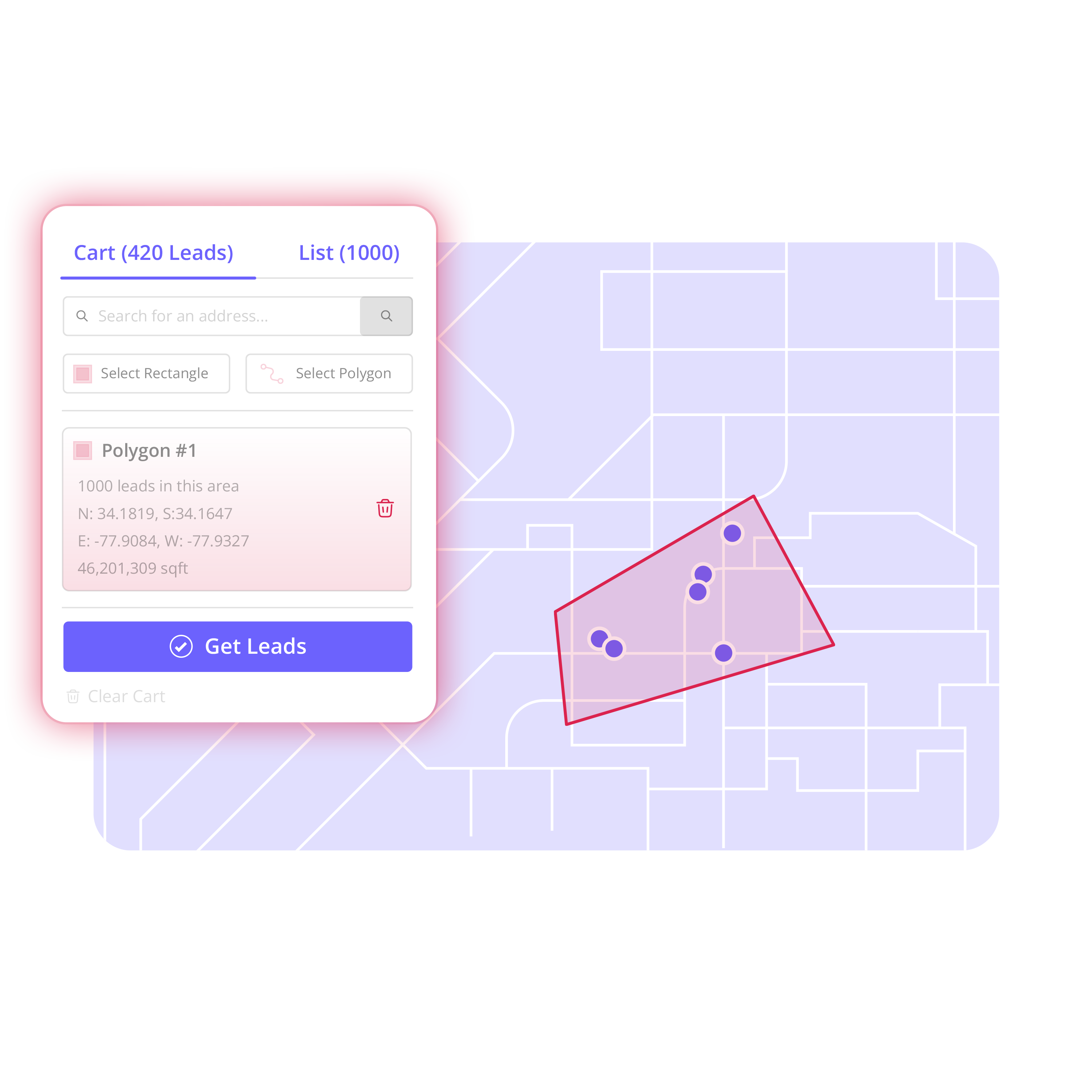
Use the map to search an address, neighborhood, ZIP code, or market. Then draw the exact boundary. Include the streets where your crew has visibility, where a rep can work efficiently, or where the campaign offer makes sense. Exclude streets that belong to another rep, sit outside your service range, or do not fit the campaign.
This step is operational, not cosmetic. A precise boundary helps a canvassing manager assign turf with fewer questions. It helps an operations manager avoid overlaps. It gives the owner a clear answer when someone asks why those properties were selected.
For example, a roofing company responding to hail damage may draw the blocks around verified damage and recent inspections rather than prospecting an entire city. A real estate investor may outline only the subdivision where the acquisition criteria fit. The workflow is the same even when the sales motion is different.
Turn the map into a property list
Once the boundary is set, find the properties inside it and review the records before anyone begins outreach. This is where a map becomes a campaign.
Not every property belongs in every campaign. A home-service company may focus on residential properties. An investor may filter for a narrower property profile. A solar team may prioritize selected streets for an initial canvassing run. The point is to build a list intentionally rather than export everything and sort it out later.
Create a dedicated list for the campaign. Give it a name that answers three questions: where it is, why it exists, and when it was created. “Oak Ridge Storm Area - September” is more useful than “New Leads 3.” Clear naming makes it easier to revisit a territory, measure activity, and avoid rebuilding the same list from scratch.
In Territory, teams can move from a selected area to property records without maintaining a separate map file and spreadsheet. The result is not a vague map pin or a collection of screenshots. It is a working list tied to a defined geography.
Enrich selectively, not automatically
Available homeowner and contact information can help a team prepare for outreach, but it should not become another source of clutter. Enrich the records your team actually intends to pursue.
That approach controls cost and keeps the list focused. A manager might first identify 800 properties in a neighborhood, then select the 250 that fit the campaign before adding available details. An acquisitions team might enrich only the records that pass its initial filters. A canvassing team may need addresses and territory assignments first, then add information for follow-up prospects later.
Available contact information does not create permission to contact someone. Teams should follow applicable laws, platform rules, internal policies, and channel-specific requirements for calls, texts, email, mail, and door-to-door outreach. Good prospecting is targeted and organized, not careless.
Organize ownership before outreach starts
A list without ownership becomes a shared pile of names. Organize records before the field team or sales team begins work.
Assign prospects to the appropriate rep, crew, territory manager, or campaign owner. Use statuses to show whether a property is unworked, attempted, contacted, qualified, scheduled, closed, or not a fit. Tags can identify the reason a record entered the list, such as storm area, neighbor of job site, maintenance offer, investor target, or direct-mail follow-up.
The best structure depends on the team. A five-person roofing company may only need a list, a few tags, and clear rep assignments. A larger solar organization may use boards and status rules to manage several canvassing teams across multiple neighborhoods. Do not overbuild the system. Organize enough to answer: who owns this record, what happened, and what should happen next?
This also protects the customer experience. When a prospect responds to a mailer, calls after seeing a yard sign, or speaks with a rep at the door, the team should be able to see whether the property is already being worked. That is harder when records live in separate spreadsheets, personal notes, and unconnected tools.
Export clean lists into the tools you already use
Neighborhood prospecting should not require replacing the systems that already run your sales process. The campaign-list layer sits between the map and the tools your team uses to execute.
After the territory is defined, the properties are selected, and ownership is organized, export a clean CSV list for the next step. Send it to your CRM, canvassing platform, direct-mail provider, dialer, or internal reporting process. Include only the fields needed for that campaign so the receiving system stays usable.
For a door-knocking campaign, that might mean addresses, rep assignments, and campaign tags. For direct mail, it may mean mailing fields and segmentation labels. For an acquisition campaign, it may include selected property details, status, and owner research fields. The right export depends on the channel, but the preparation work should happen before the file leaves the territory workflow.
Measure the territory, not just the outcome
Sales results matter, but territory-level visibility helps managers improve the process before the final numbers arrive. Review how many properties were included, how many were assigned, how much of the area was worked, which streets produced conversations, and where duplicate effort appeared.
If a neighborhood did not perform, do not assume the approach failed. The area may have been too broad, the timing may have been wrong, the offer may not have fit, or the team may not have completed coverage. Geographic prospecting gives you a defined unit to evaluate and adjust.
Over time, this creates a practical operating habit: document the area, build the list, assign the work, track the status, and reuse what works. Your team spends less time cleaning data and more time working a territory with purpose.
The next neighborhood campaign does not need to begin with a spreadsheet and a guess. Start with the streets your team has a reason to work, then make every property on the list accountable to a real plan.