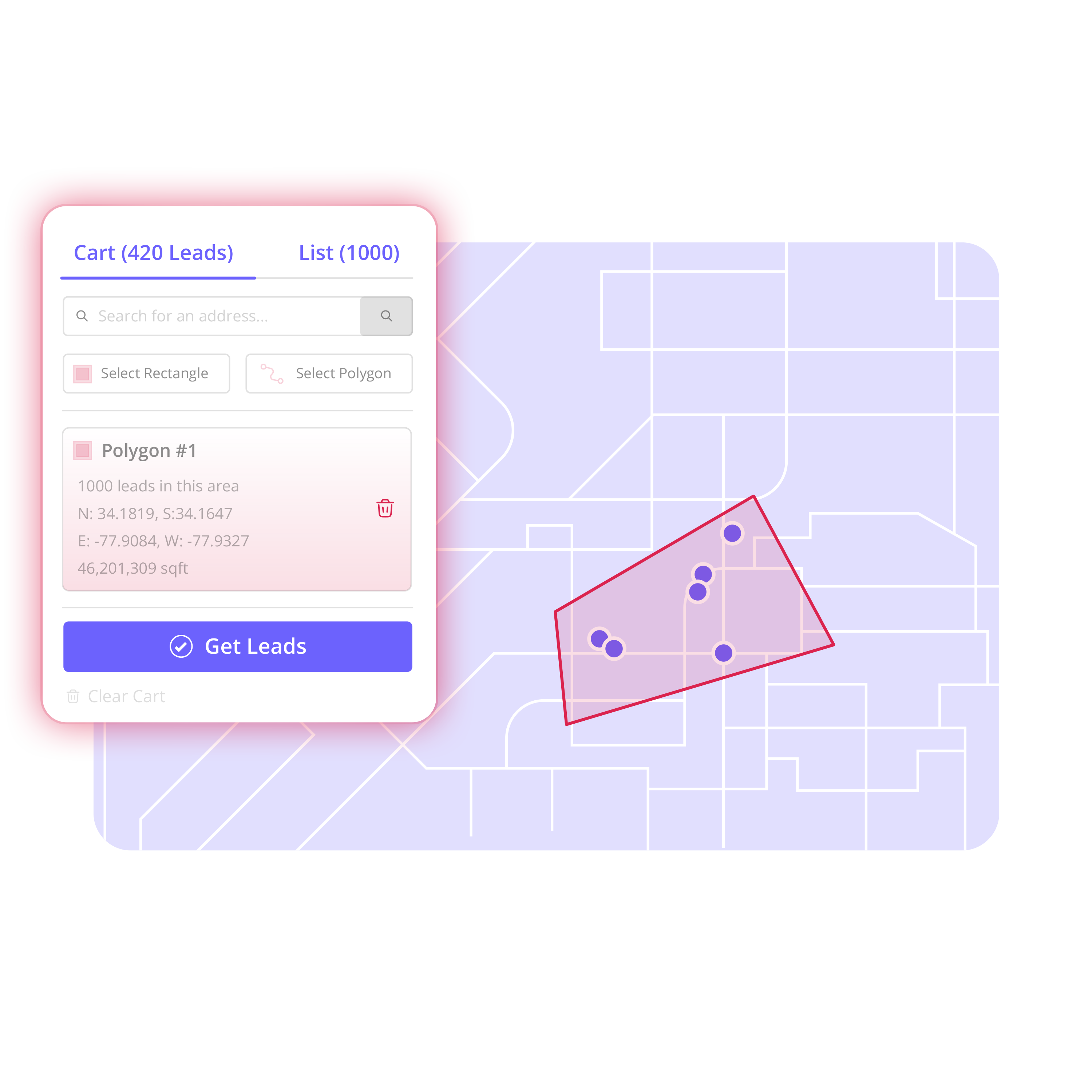

A good map based prospecting guide starts with a simple decision: where does your team actually want to sell next? Not a broad ZIP code purchased from a list broker. Not a spreadsheet of records your reps cannot place on a map. Start with the neighborhood, streets, or service area that makes sense for the campaign.
For a roofing company, that might be the blocks around a completed reroof. For an HVAC team, it could be a service area where the company wants more maintenance customers. For a property manager or investor, it may be a defined acquisition zone. The workflow is the same: choose the area, find the properties, build the list, and give the team a clear campaign to work.
Why map-based prospecting works for local sales teams
Geography gives prospecting a practical starting point. Your team already knows where work is happening, where storms have created demand, where referrals are coming from, and where the company wants to expand. A map turns that local knowledge into an organized prospecting plan.
This matters because generic lists create extra work. A list may include properties outside your target area, duplicate contacts, records that belong to another rep, or addresses that do not fit the campaign. Sales managers then spend time filtering spreadsheets, redrawing territories, and explaining which prospects each person should own.
Map-based prospecting puts the territory first. You see the area before you build the contact list. That gives owners, sales managers, and canvassing teams more control over campaign boundaries and helps prevent unnecessary overlap.
It is not a replacement for good sales judgment. A tight neighborhood around a recent job may be a strong fit for one roofing campaign, while a storm-affected area or an underserved service zone may be better for another. The point is to choose intentionally instead of accepting whatever list happens to be available.
The map based prospecting guide: from territory to campaign
The fastest path from map to prospect list is a repeatable six-step workflow. Keep the process simple enough that a sales manager can set up a campaign without turning every new territory into a spreadsheet project.
1. Choose the area you want to work
Begin with a real business reason. A completed roofing job is one of the clearest examples. Locate the job area on the map, then look at the surrounding streets where your company can build neighborhood visibility and give reps a focused place to start.
Draw a rectangle for a simple block of properties, or use a polygon when the territory follows irregular streets, subdivision lines, commercial boundaries, or a storm-response area. The goal is not to draw the largest possible area. It is to draw an area your team can realistically work.
For roofing sales organizations, this is how you turn your last roofing job into your next neighborhood campaign. For solar or door-to-door teams, it can define a canvassing zone. For acquisition teams, it can establish a property search area that fits a buy box.
Before moving on, check for existing contacts in the area. An existing-contact overlay can help your team avoid rebuilding a list around records already in your system or assigning new activity without context.
2. Find available properties inside the boundary
Once the boundary is set, review the properties available within it. Map layers and clustering help you understand the density of the area without treating the map like a static address directory.
At this stage, ask operational questions. Is the area too large for one rep? Does it cross into another rep's territory? Are there streets you want to exclude because they have already been worked, fall outside your service model, or are assigned elsewhere?
Smaller, well-defined areas are often easier to execute than a large, vague territory. A 150-property campaign with a clear owner, a clear message, and a defined follow-up process may be more useful than a 2,000-record export that sits untouched.
3. Select the properties that fit the campaign
Select the records your team intends to pursue. This is where map-first prospecting becomes more useful than downloading a broad list and hoping the cleanup happens later.
You can select individual properties when the campaign needs precision, or select a larger group within the area when the territory is ready to work as a whole. For example, a roofing manager may select the streets closest to a completed job first, then expand the campaign later if the team has capacity.
Be disciplined here. The list should match the plan. If a rep is assigned to work 80 doors this week, do not hand them 400 unorganized records. If direct mail is planned for a particular subdivision, do not add nearby areas just because they are visible on the map.
4. Create an Audience before you enrich
Turn the selected properties into an Audience. An Audience gives the campaign a name, a boundary, and a working record of what the team decided to pursue.
Use clear names that make sense six weeks later. “Oak Ridge reroof follow-up - North streets” is more useful than “New List 4.” Include the campaign purpose in the name when possible, especially when multiple reps or managers build territories at the same time.
This step creates accountability. Instead of passing around a filtered spreadsheet with unclear ownership, the team has a defined group of prospects tied to a particular market, campaign, or sales objective.
Territory is built for this exact middle ground: choose the area, build the list, and organize it before the data moves into the next stage of your sales process.
5. Enrich the records that matter
Build the territory first. Enrich what matters.
Contact enrichment is most useful after the list is narrowed to the properties your team actually plans to work. Add available homeowner or property-owner contact information to selected records rather than enriching a large area with no clear outreach plan.
This approach helps control cleanup work and keeps the campaign focused. A roofing company may enrich a priority group for direct mail or outbound calling while leaving the rest of a broader neighborhood Audience untouched until the team is ready.
Available contact information does not mean a prospect requested contact or consented to marketing. Your outreach process should follow applicable rules, company policies, and the requirements of each channel. The value here is organization: your team has the property and owner information needed to prepare the campaign responsibly.
6. Organize ownership, activity, and next actions
A prospect list only helps if people know what to do with it. Use statuses, assignees, notes, activity, and contact profiles to turn a selected area into a manageable work queue.
A canvassing manager might assign one section of a neighborhood to each rep. A sales manager may use statuses to separate unworked records from active conversations and follow-up opportunities. An operations manager may add notes about exclusions, campaign timing, or local context that the team needs to see.
Keep the setup proportional to the campaign. A lightweight process is usually enough: assign the records, establish a status convention, and define the expected next action. You do not need a full field-service system to prepare a neighborhood prospecting list.
7. Export a clean list when the campaign needs it
Some teams will continue working the Audience and contact records in the platform. Others need a CSV for the sales, calling, mailing, or outreach tools they already use. Export only the fields and records that belong in that campaign.
Before exporting, do one final check: confirm the territory, remove records that should not be included, review ownership, and make sure the file name identifies the campaign. This small step prevents the familiar problem of multiple versions of the same list circulating across the team.
Common map prospecting mistakes to avoid
The biggest mistake is starting with data instead of geography. When a team downloads a large list first, it often spends hours trying to create a usable territory afterward. Start with the neighborhood so the data serves the campaign.
Another mistake is treating every visible property as an immediate priority. Capacity matters. Build a list your team can work, then expand with intention. It is also worth setting basic ownership rules before the campaign starts. Overlapping territories and duplicate records are easier to prevent than to untangle after outreach begins.
Finally, avoid enriching everything by default. Selective enrichment keeps effort tied to a real prospecting plan and makes the resulting data easier to manage.
Put the next neighborhood on the map
The practical advantage of map-based prospecting is clarity. Your team can see where it is going, which properties belong in the campaign, who owns the work, and what data needs to move forward.
Choose the area. Build the list. Then give your reps a territory they can act on instead of another spreadsheet they have to interpret.