
A new ZIP code is not a service area plan. Neither is a vague instruction to “work the north side” or a purchased list of homeowners scattered across three counties. HVAC service area expansion works when the area, the properties, the campaign, and the owner of the work are clearly defined before reps start calling, knocking, or mailing.
For an HVAC company, expansion often starts with a practical opportunity: technicians are already completing calls beyond the current core market, a nearby suburb has enough home density to support a maintenance campaign, or a competitor's service gap creates room to enter. The opportunity is real. The operational problem is turning it into a usable prospecting plan without creating duplicate records, overlapping reps, or another spreadsheet no one trusts.
Choose the area. Build the list. Assign the work. That is the foundation.
HVAC service area expansion starts with boundaries
Service maps and prospecting territories are related, but they are not the same thing. Your operational service area may cover every address you can reasonably reach with a truck. Your prospecting area should be narrower: the streets and neighborhoods your team can work consistently, support with capacity, and measure as a campaign.
This distinction matters when a company expands into an adjacent town. A broad radius around a branch may include commercial corridors, apartment-heavy blocks, properties outside the preferred housing profile, and streets that are difficult for a canvassing team to cover. A tighter boundary lets you focus the campaign on the homes and neighborhoods that match the offer.
Start with what your field team already knows. Look at recent service calls, installation jobs, maintenance agreements, technician drive routes, and referrals. Then decide whether the first campaign should target the whole town, selected subdivisions, or the blocks surrounding existing jobs. Smaller, well-defined territories are easier to assign and easier to evaluate.
1. Choose an expansion area your operations can support
Expansion is not just a marketing decision. A campaign can create demand in places where response times, technician coverage, or installation scheduling are already strained. Before building a list, confirm the practical constraints: travel time, service capacity, licensing requirements, local competition, and the types of work you want more of.
For example, a company adding a nearby suburb may want to begin with a maintenance-plan campaign rather than pushing a large replacement offer. That approach can help the team establish a local customer base while testing demand. Another company with open installation capacity may focus on older owner-occupied homes where replacement conversations are more likely to fit its goals.
The right first territory depends on the business. The point is to choose it deliberately, not inherit it from a radius setting or a generic list.
2. Draw the streets your team will actually work
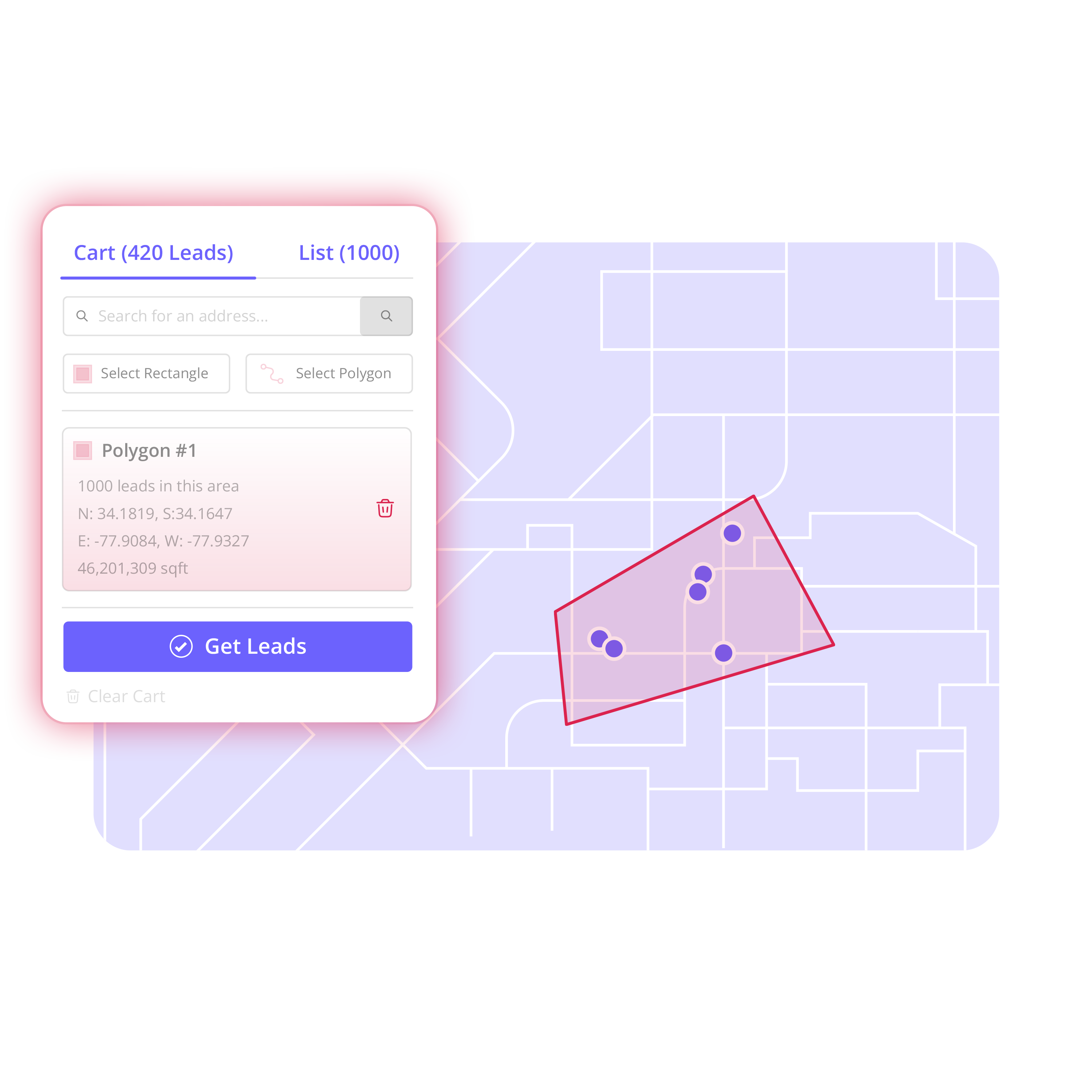
Once you choose the market, define the boundary at street level. Draw the exact neighborhood, subdivision, ZIP code section, or service pocket your team wants to prospect. Exclude areas that do not fit the campaign, including apartment complexes, commercial zones, difficult access areas, or territory already assigned to another rep.
Precise boundaries solve a common expansion problem: two teams believe they own the same neighborhood. One rep starts door knocking while another sends direct mail to the same homes. The company pays twice, customers receive mixed messages, and managers cannot tell which effort produced the response.
A clear territory creates accountability. It gives a sales manager a defined set of properties to assign, track, revisit, or pause. It also makes it easier to expand methodically. Instead of opening an entire county at once, build one campaign-ready pocket, work it, review the results, and add the next pocket when the team is ready.
Turn the map into a property list
A boundary only becomes useful when it produces a clean working list. HVAC teams need more than a map full of pins. They need records they can organize around the campaign: properties in the territory, the status of each prospect, the rep responsible, and the next action.
Use the selected area to find properties inside the boundary. Review the results before treating every record as a prospect. Depending on the campaign, you may want to filter out properties that do not match the offer or split the area into smaller routes. A replacement-focused campaign and a maintenance agreement campaign may use the same map but different lists.
3. Build one list for one campaign purpose
Avoid combining every possible prospect into one export. A list becomes harder to work when it mixes old leads, new territory properties, current customers, commercial accounts, and referrals without a clear status or source.
Build the list around a specific campaign purpose. It could be “Fall tune-up outreach in Brookfield,” “replacement prospects near recent installs,” or “new service-area door-knocking route.” Name it so a manager can understand the intent without opening the file.
This also helps with measurement. If the campaign underperforms, you can review the area, the offer, the channel, and the follow-up process. When every record is thrown into a master spreadsheet, those decisions become guesswork.
4. Enrich selected records, not every address
Property records give the team a place to start. Available homeowner and contact information can help prepare the outreach list, but it should be added selectively to the records the company actually plans to pursue.
This is where discipline saves time and cost. A company testing a 600-home neighborhood may first identify the properties, remove records that do not fit the campaign, then enrich the remaining records needed for outreach. There is little value in enriching a broad market before deciding which blocks, property types, or routes the team will work.
Keep compliance and permission separate from data availability. Available contact information does not itself create permission to call, text, or email someone. Your team should follow applicable laws, internal policies, suppression rules, and channel-specific consent requirements before outreach.
Organize work before the campaign launches
Expansion fails when a good list lands in an inbox with no owner, no status, and no next step. The list needs to fit the sales process your team already uses, whether that means a CRM, a canvassing platform, a direct-mail workflow, or a manager's assigned call blocks.
5. Assign ownership and track status
Organize prospects by territory, campaign, rep, and stage. Use tags and filters to separate unworked properties from attempted contacts, scheduled appointments, no-interest records, and follow-up opportunities. If a rep leaves or the territory changes, a manager should be able to see exactly what remains without rebuilding the list.
For field teams, route-level ownership is especially useful. Instead of assigning one large expansion market to five people, divide it into workable sections. Each rep knows where to start. Managers can see coverage gaps. Marketing can avoid sending mail to a section that has already been removed from the active campaign.
Clear organization also protects existing customer relationships. Before export, compare the campaign list with customer records and recent opportunities in your existing systems. You may decide to exclude active customers, route them into a different offer, or assign them to the account owner rather than a new-market rep.
6. Export clean data into the tools you already use
The final step is not another manual cleanup project. Export a clean CSV with the fields your next system needs: property address, campaign name, territory, assigned rep, tags, and selected contact details where appropriate. Then load it into the CRM, direct-mail platform, canvassing tool, or calling workflow your team already uses.
Territory by Top Interaction fits this part of the process. It helps teams choose an area, find properties inside it, build and organize a focused list, enrich selected records, and export the campaign without forcing a replacement for the rest of the sales stack.
Keep the source territory attached to the exported campaign. When an appointment comes in three weeks later, the team should be able to trace it back to the neighborhood, route, offer, and rep activity that created the opportunity. That context helps you make better expansion decisions than a simple count of leads or calls.
Expand in repeatable service pockets
The most reliable HVAC growth plans do not treat expansion as one large geographic leap. They create a repeatable process for opening and working service pockets. Start with a defined area, give it a clear campaign purpose, assign it, and review what happened before widening the boundary.
A neighborhood with strong response but poor appointment capacity may need a slower rollout. A territory with low response may need a different offer, a tighter property filter, or a decision to move on. Neither result is wasted if the area and activity were organized well enough to learn from.
Expansion gets easier when your team can point to a map and say: this is the next area, these are the properties, this is who owns them, and this is what happens next.