
A generic list might contain thousands of names, but it rarely answers the question your team needs answered: who is inside the streets, neighborhood, or service area we plan to work this week? Off market property lists work best when they start with a defined territory, not a broad database export. Choose the area first. Then build a list your team can actually assign, organize, and use.
For roofing, solar, HVAC, and local acquisition teams, that distinction matters. A storm-response crew may need properties within a few blocks of recent jobs. A canvassing manager may need every address on one side of a boundary so reps do not overlap. An investor may want a tightly defined acquisition zone rather than another county-wide file full of records that will never be worked.
The objective is not to collect the most records. It is to create a campaign-ready list with a clear reason for every property included.
What makes an off-market property list usable?
An off-market property list is a group of properties selected for outreach outside of an active public listing search. It may support door knocking, direct mail, outbound calling where permitted, local market research, or acquisition outreach. The list can include homeowner and available contact information, but a contact record is not permission to contact someone. Your team still needs to follow applicable federal, state, and local rules, along with your own outreach policies.
A usable list has four qualities: it is geographically intentional, relevant to the campaign, organized for execution, and clean enough to move into the tools your team already uses.
That rules out a common approach: buying a massive file, filtering it in a spreadsheet, removing duplicates, and trying to figure out which rep owns which streets. Broad data can have a place in market research, but it is often a slow starting point for a focused local campaign.
The better approach is to begin with a map and turn the exact area into a workable property list.
Build off market property lists from the map out
The workflow is straightforward: choose the area, find properties, build the list, enrich selected records, organize prospects, and export the campaign. Each step removes a decision that otherwise gets pushed into a spreadsheet or left to individual reps in the field.
1. Choose the area your team can actually work
Start with the geographic reason for the campaign. It might be a neighborhood surrounding a completed roof, an expansion ZIP code, a storm-affected corridor, a solar-friendly subdivision, or a defined investment zone.
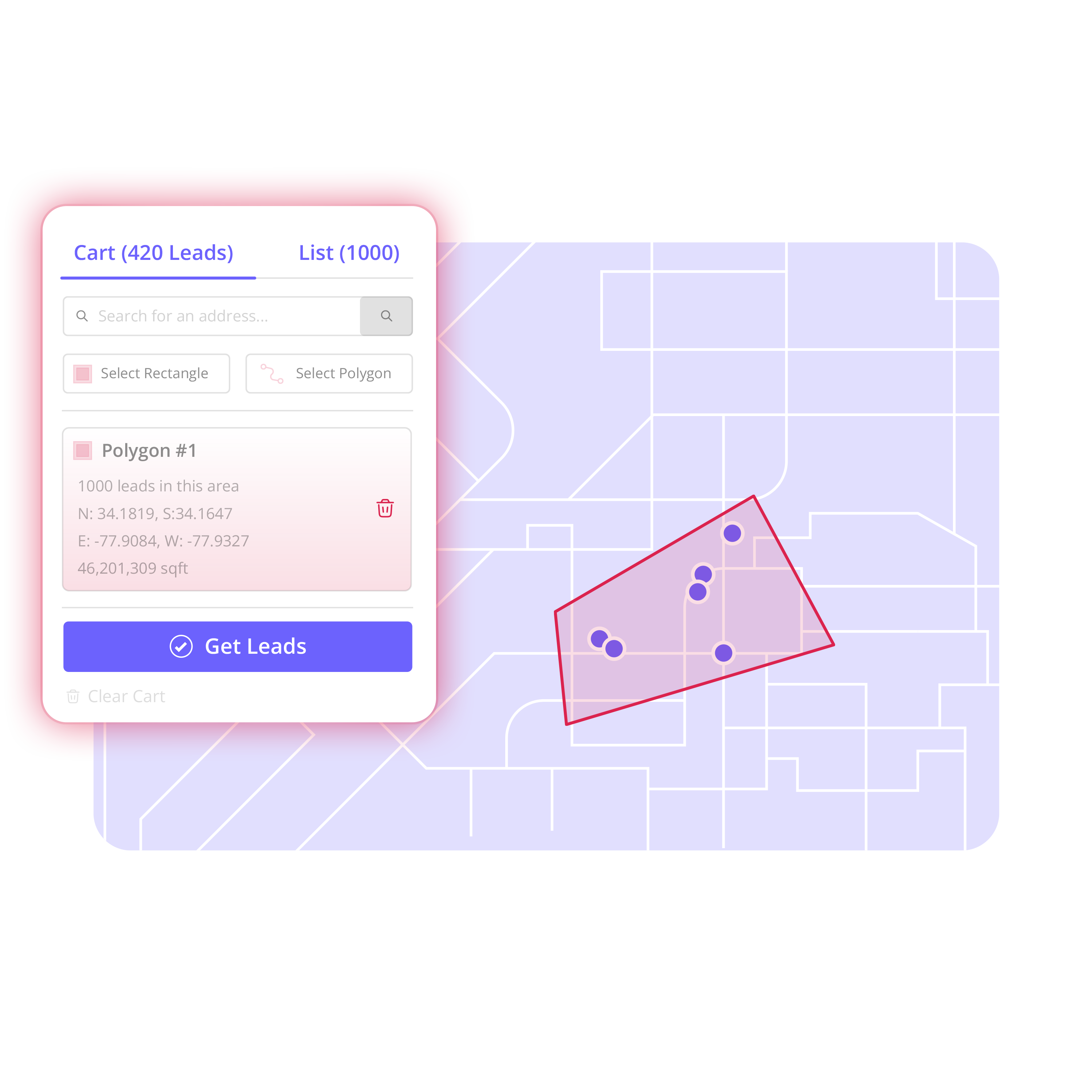
Search for an address, neighborhood, ZIP code, service area, or market. Then draw the boundary that matches the real opportunity. A custom territory is often more useful than a ZIP code because ZIP codes do not respect how crews travel, where job clusters sit, or how managers assign reps.
For example, a roofing team with three recent installations may choose the blocks surrounding those jobs instead of targeting an entire city. That gives the team a concentrated area where the work is visible and the message is relevant. It also helps the manager set a realistic expectation: work these streets first, then assess results before expanding.
Precision is not always the right choice. If you are building a direct-mail test, a wider service area may be appropriate. If you are assigning door-to-door teams, tighter boundaries usually make more sense. The right territory depends on the campaign, the number of reps, travel time, and how quickly you intend to follow up.
2. Find the properties inside the boundary
Once the territory is set, identify the properties inside it. This step turns a geographic idea into an addressable campaign universe.
Do not assume every property belongs in the same list. A home-service company may separate residential properties from commercial locations. An investor may focus on a specific property type or ownership profile. A solar team may want to remove addresses already assigned to a prior campaign.
The point is to make selections before outreach begins. A rep should not have to decide at the doorstep whether an address is part of the campaign. Sales operations should define the working area and the inclusion rules up front.
This also makes performance easier to evaluate. When a campaign has a clear boundary and a known number of selected properties, you can compare activity across territories without guessing what was actually worked.
3. Build a list with a clear campaign purpose
Add the properties you want to pursue to a dedicated list. Name it so anyone on the team understands what it is without opening it. “North Ridge storm follow-up - September” is more useful than “New Leads 4.”
A good list name carries the location, campaign, and timing. That creates a record of why the properties were selected and prevents fresh records from being mixed with old, unrelated outreach.
At this stage, ownership matters. Assign a territory, list, or segment to the right rep or team before records scatter across separate files. If two canvassers are working adjacent areas, use boundaries and statuses to show where one assignment ends and the next begins.
This is where territory-first prospecting solves a practical field problem: overlapping effort. Without a shared working list, reps can knock the same streets, marketing can mail properties sales already contacted, and managers lose a clean view of coverage. Build once, organize centrally, and let the campaign move forward with fewer handoffs.
4. Enrich only the records worth pursuing
Property records provide the starting point. Available homeowner and contact information can help your team prepare an outreach plan, but enriching every property in a large territory is not always necessary.
Selective enrichment gives you more control. Start by choosing the properties that fit the campaign, then add available information to those records. For an investor, that may mean prioritizing a smaller acquisition shortlist. For a roofing team, it may mean enriching a group of homes near a job site after the manager confirms the area is ready for outreach.
This approach keeps the list focused and reduces unnecessary data handling. It also prevents a common failure point: pulling more information than the team has the capacity or intent to use.
Before exporting or contacting anyone, review the fields your outreach process requires. Different campaigns may need different details. A door-knocking list may primarily need addresses, turf assignments, and statuses. A direct-mail campaign may need clean mailing fields. A calling workflow may require additional compliance review and suppression processes.
5. Organize prospects before the field work starts
A list becomes operational when the team can filter, sort, assign, and update it without building a new spreadsheet every morning. Use lists for campaign groups, tags for meaningful characteristics, and statuses for the current stage of work.
For a solar canvassing campaign, a manager might use a status such as unworked, attempted, conversation, follow-up, or do not revisit. For an HVAC growth campaign, tags could distinguish a new service-area test from a reactivation effort. For an acquisition team, a board can show which properties are being researched, reviewed, or prepared for outreach.
Keep the system simple enough that reps will use it. Too many tags and statuses create inconsistent updates. Too few create a list that cannot answer basic management questions. Start with the decisions your team makes every day: Who owns this record? Has it been worked? What should happen next? Is it part of this campaign or another one?
That clarity is especially valuable when territory boundaries change. If a manager expands a market, pauses a neighborhood, or reassigns a rep, the records should remain organized by campaign rather than disappearing into a general contact pool.
Export clean lists into the tools you already use
The final step is not to force your team into a new sales process. It is to export the clean list into the CRM, canvassing platform, direct-mail workflow, or reporting process already in place.
Before export, filter out records that do not belong in the current campaign. Check for duplicate entries, confirm assignments, and make sure statuses are current. A smaller, clean CSV usually creates less downstream work than a larger export with vague ownership.
Territory by Top Interaction is built for this middle layer between a map and your existing sales tools. Use it to choose the area, identify properties, build the list, selectively enrich records, organize the campaign, and export what your team needs. It does not need to replace the CRM or field platform your team relies on.
For many teams, speed comes from removing the spreadsheet cleanup between those steps. A manager should be able to see a target area, define it, select the right properties, and hand reps a clear working list without waiting days for a purchased file or manual sorting.
When broad property data still makes sense
Territory-first lists are not the answer to every prospecting need. If you are researching a large market, modeling regional demand, or running a broad brand-awareness campaign, wider property data can be useful. The trade-off is that broad data gives you reach, while a defined territory gives you control.
The strongest process often uses both at different stages. Use broader data to understand where opportunity may exist. Then draw the streets, neighborhoods, or service areas your team is ready to work and build a focused campaign list from there.
That is the practical standard for off-market prospecting: do not let the size of a database dictate the shape of your campaign. Choose the ground your team can cover, build the list around it, and give every record a clear next step.