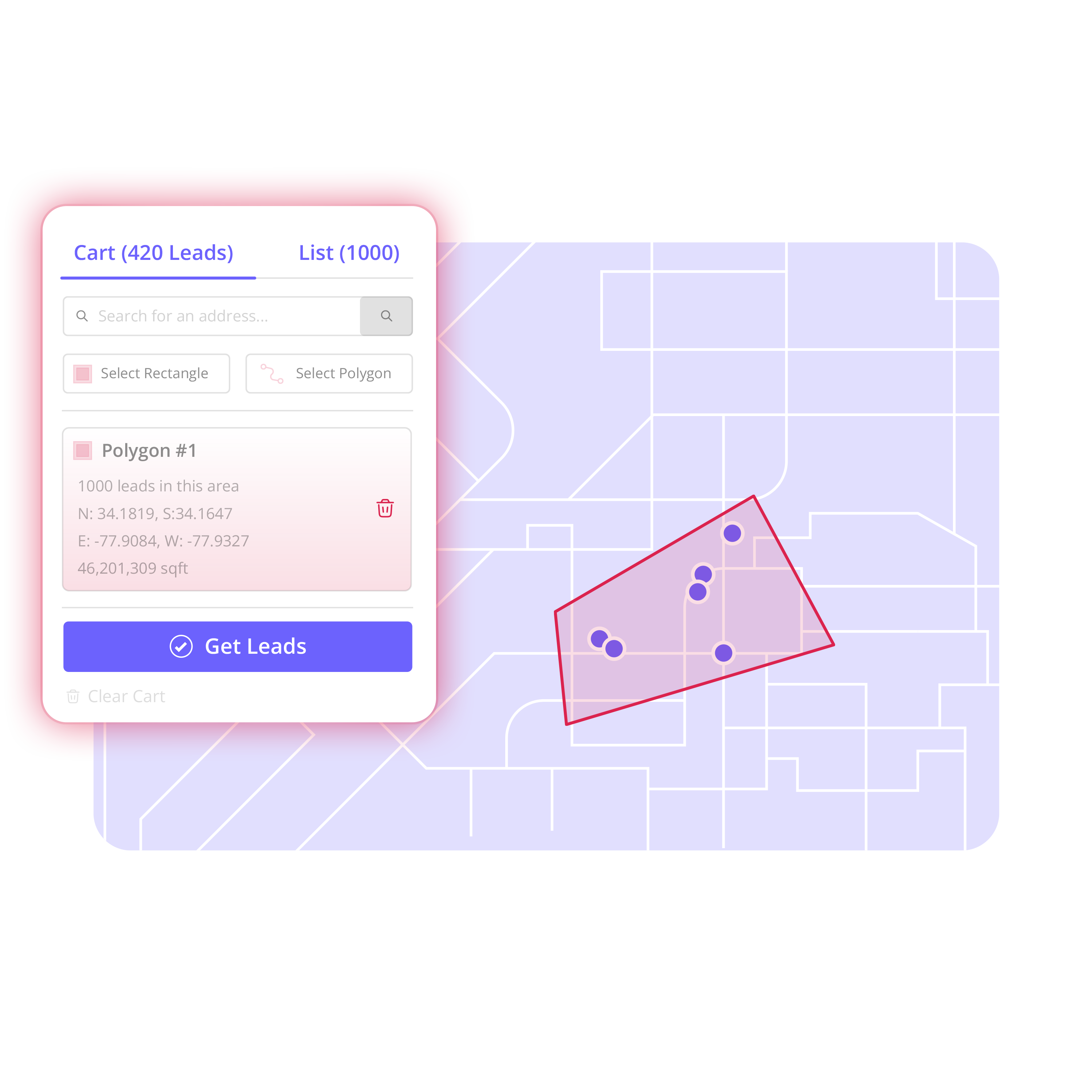

A jobsite can give your team a better starting point than a broad ZIP code or a generic purchased list. When you create a jobsite radius list, you turn an active project into a defined group of nearby properties your team can canvass, call where permitted, mail, or assign for follow-up. The goal is not to work every address near a pin. The goal is to choose the streets with a real reason to be in the campaign.
For a roofing company, that might mean homes surrounding a recent replacement in a neighborhood with similar roof age. For solar, it could mean the blocks around an installation where the homes have comparable exposure and property profiles. For an investor, it may be a tight acquisition zone around a property that signals a specific ownership or condition pattern.
How to Create a Jobsite Radius List
Start with the jobsite address, but do not let a circular boundary make the decision for you. A radius is a fast way to find the initial opportunity area. Your team still needs to shape that area around roads, housing types, rep capacity, local rules, and the campaign you plan to run.
1. Choose the jobsite and the campaign goal
Pick a jobsite that gives prospects a relevant reason to hear from you. A visible roof replacement, HVAC installation, solar project, or renovation can work well because it creates local context. The jobsite should also fit the service area your crew can support. There is little value in building a campaign that produces work outside your preferred geography or scheduling capacity.
Define the outreach goal before you pull properties. Are reps door knocking for inspections? Is the team preparing a direct-mail drop? Are you building a follow-up list for phone outreach using available contact data and your own compliance process? Each goal changes the size and makeup of the list.
A canvassing manager may want 150 to 250 doors that a two-person team can work over several shifts. A marketing manager may need 1,000 nearby properties for a mail campaign. A sales manager may only need a focused group of homes for assigned reps. Start with the outcome, then build to the right count.
2. Set a radius that matches the neighborhood
There is no universal radius. In a dense subdivision, a quarter-mile can include enough homes for a full campaign. In a rural or spread-out market, a one- or two-mile starting radius may be more realistic. Use the jobsite as the center point, then look at the number of properties inside the boundary rather than relying on distance alone.
The right radius depends on how prospects actually move through the area. A highway, creek, gated entrance, commercial strip, or dead-end road can make nearby homes impractical to reach. A circle may place homes within half a mile of the jobsite while putting them on the other side of a barrier your reps will not cross.
Treat the radius as a first pass. It helps you locate properties quickly. Precision comes next.
3. Draw the streets your team will actually work
Once you can see the properties around the jobsite, draw a custom territory around the blocks that belong in the campaign. Include connected streets, subdivisions, or clusters where the homes make sense for your offer. Exclude apartments, commercial parcels, inaccessible streets, and areas already assigned to another rep.
This is where geographic control matters. A radius-only list often creates cleanup work later because it includes addresses that look close on a map but do not fit the field plan. Drawing the actual territory gives reps a practical route and gives managers a clear answer to a common question: who owns this area?
For example, a roofer with a completed project on Maple Drive may begin with a half-mile radius. The final territory might include Maple Drive, the two connected cul-de-sacs, and the adjacent subdivision entrance. It may exclude the townhome complex across the arterial road and the older neighborhood where the homes have a very different roof profile.
4. Find properties and build the working list
After defining the area, review the properties inside it and add the records you want to work to a campaign list. Do not assume every property belongs simply because it falls within the line. Filter based on what your team knows about the market and the campaign.
Useful decisions include property type, visible fit for the offer, prior contact status, existing customer records, and whether a property is already being worked by someone else. If your CRM or spreadsheet shows recent activity, use that information before assigning new doors. The cleanest list is not the biggest list. It is the list with a clear purpose and no unnecessary overlap.
Territory by Top Interaction supports this workflow by letting teams choose an area, find the properties inside it, and add selected records to Contacts. Instead of exporting a broad map search and sorting it later, build the campaign list from the properties your team intends to pursue.
5. Enrich only the records that matter
A jobsite radius campaign does not always require contact enrichment. A door-knocking team may need street addresses, routes, statuses, and ownership assignments more than anything else. A direct-mail campaign may need mailing details. A phone or email workflow may require available homeowner and contact information for a smaller, qualified group.
Enrich selectively. It keeps the list focused and reduces time spent processing records that will never reach the outreach stage. It also gives managers more control over what data is used for each campaign.
Available contact information is not permission to contact someone. Your team remains responsible for following applicable laws, internal policies, do-not-contact requirements, and channel-specific rules. Build the list carefully, then run outreach through the process your business has approved.
6. Organize the list before reps start working it
A radius list becomes operational when everyone can see its status and ownership. Name the list clearly with the jobsite, neighborhood, campaign type, and date. For example: “Maple Drive Roof - Northfield Canvass - October.” That name tells a manager what it is without opening the file.
Then organize records using statuses, tags, filters, and assignments that match your sales process. A simple canvassing workflow may use New, Assigned, Attempted, Spoke With Owner, Inspection Set, Not Interested, and Do Not Knock. An acquisition team may track Researching, Contacted, Follow-Up, Offer Review, and Closed.
Keep jobsite radius lists separate when the message or rep assignment is different. Combining multiple jobsites into one large neighborhood file can make reporting harder and create confusion when a prospect asks which nearby project prompted the conversation. You can still filter across campaigns later, but each active jobsite campaign should have a clear owner and a defined boundary.
7. Export a clean file into the tools your team already uses
The final step is not another spreadsheet cleanup project. Export the fields your next tool needs and leave out the fields it does not. A canvassing platform may need addresses, notes, assignments, and status. A mailing provider may need names and mailing addresses. A CRM import may require a specific column order and source label.
Before exporting, check for duplicates, incomplete addresses, properties that should be excluded, and records assigned to the wrong person. Add a source field such as “Jobsite Radius - Maple Drive” so your team can measure response, appointments, and outcomes by campaign. That source label matters when you compare one neighborhood strategy with another.
Common mistakes that weaken a jobsite radius campaign
The most common mistake is treating distance as the only qualification. Nearby does not always mean relevant or reachable. Another is making the radius too large because more records feel like more opportunity. Large lists often slow down canvassing, dilute the message, and leave reps unclear about where to start.
Teams also lose momentum when they export before organizing. A raw file with no assignments, tags, or status rules becomes another disconnected spreadsheet. Build the operating structure first. Then send a clean list to the people and systems responsible for outreach.
Finally, avoid using the jobsite as a script crutch. The nearby project provides context, not a substitute for an honest, useful conversation. Reps should be prepared to explain why they are in the area, what service they offer, and what the next step looks like.
A good jobsite radius list should make the next field shift obvious. Your team should know which streets to work, which properties belong in the campaign, who owns each record, and where the results will be tracked. Choose the area. Build the list. Give the team a defined place to start.