
A roofing crew finishes a visible replacement on Tuesday. By Wednesday, the sales team should know which nearby streets to work, which homes belong in the campaign, and who owns the follow-up. That is how roofing companies build neighborhood prospect lists that crews can actually use - not by buying a broad ZIP-code file and sorting it later.
The strongest neighborhood lists start with a clear geographic reason to prospect. It might be recent work, a storm path, an older subdivision, a referral cluster, or a service-area expansion. The goal is simple: choose the area, identify the properties, and turn those records into an organized campaign before momentum fades.
Start With a Prospecting Trigger, Not a Giant Market
A neighborhood is not automatically a campaign. A good territory has a reason behind it.
For a roofing company, recent job sites are one of the most practical triggers. A new roof provides social proof, gives canvassers a relevant opening, and helps direct-mail teams build a message around visible work nearby. The right list may include the streets around the job, but it does not need to include every house in a five-mile radius.
Storm response is another common trigger. In that case, the boundary may follow the affected area, but the working territory still needs definition. A broad storm footprint can contain too many properties for one team, too many competing contractors, or areas where your crews cannot schedule work promptly. Break the area into manageable zones and assign them deliberately.
Other useful triggers include neighborhoods with aging housing stock, service areas where your company wants more density, or streets near a cluster of past customers. The trigger shapes the message and the size of the list.
How Roofing Companies Build Neighborhood Prospect Lists
The process works best when the map comes first and the contact data comes second. That order gives the company control over where it works instead of forcing the team to make do with a generic list.
1. Choose the exact area
Start with a known address, neighborhood, ZIP code, service area, or local market. Then draw the streets your team intends to work.
Be specific. If the opportunity is centered on a completed roof, choose the surrounding blocks where homeowners can see the work or where a canvassing team can realistically walk in one shift. If the opportunity is storm related, divide the response area into zones that match crew capacity and sales coverage.
A precise boundary prevents two common problems: wasting time on properties that do not fit the campaign and creating overlap between representatives. It also gives managers a straightforward answer when a rep asks, "What am I working this week?"
The right size depends on the channel. A door-knocking route may be a few hundred tightly grouped homes. A direct-mail campaign may cover a wider area. A phone outreach list may need additional filters before it is ready. Build the territory around the actual motion, not around the maximum number of records available.
2. Find the properties inside the boundary
Once the territory is drawn, identify the property records within it. This is where many teams lose time when they rely on disconnected maps, purchased files, and spreadsheets.
The working list should show the physical address first. Roofing is a property-based sale, so the address is the anchor for every next step: routing, field verification, job-site proximity, direct mail, and CRM matching.
Review the map before adding every record. Remove obvious exclusions when the campaign calls for it, such as commercial buildings in a residential neighborhood, addresses outside the practical route, or properties that have already been assigned to another rep. A larger list is not automatically a better list. A list that matches the campaign is better.
This is also a good point to check existing customers, open estimates, and recently completed jobs in your sales system. You do not want a canvasser knocking on the door of a homeowner already working with your office. Clean ownership and suppression rules protect the customer experience and prevent internal confusion.
3. Build a campaign list, not a raw property dump
Add the selected properties to a dedicated list with a clear name. Use a naming convention that tells the team what the list is and why it exists, such as "Maple Grove - Job Site Saturation - June" or "Northside Hail Zone - Phase 1."
That detail matters once the team has several campaigns in motion. A vague file name like "Leads Final 2" creates cleanup, duplicate work, and questions nobody can answer later.
Keep each list tied to one primary purpose. A job-site saturation list and a storm-response list may overlap geographically, but they should not necessarily share the same message, owner, or follow-up schedule. Separate lists make it easier to set expectations and measure activity without treating every property as the same opportunity.
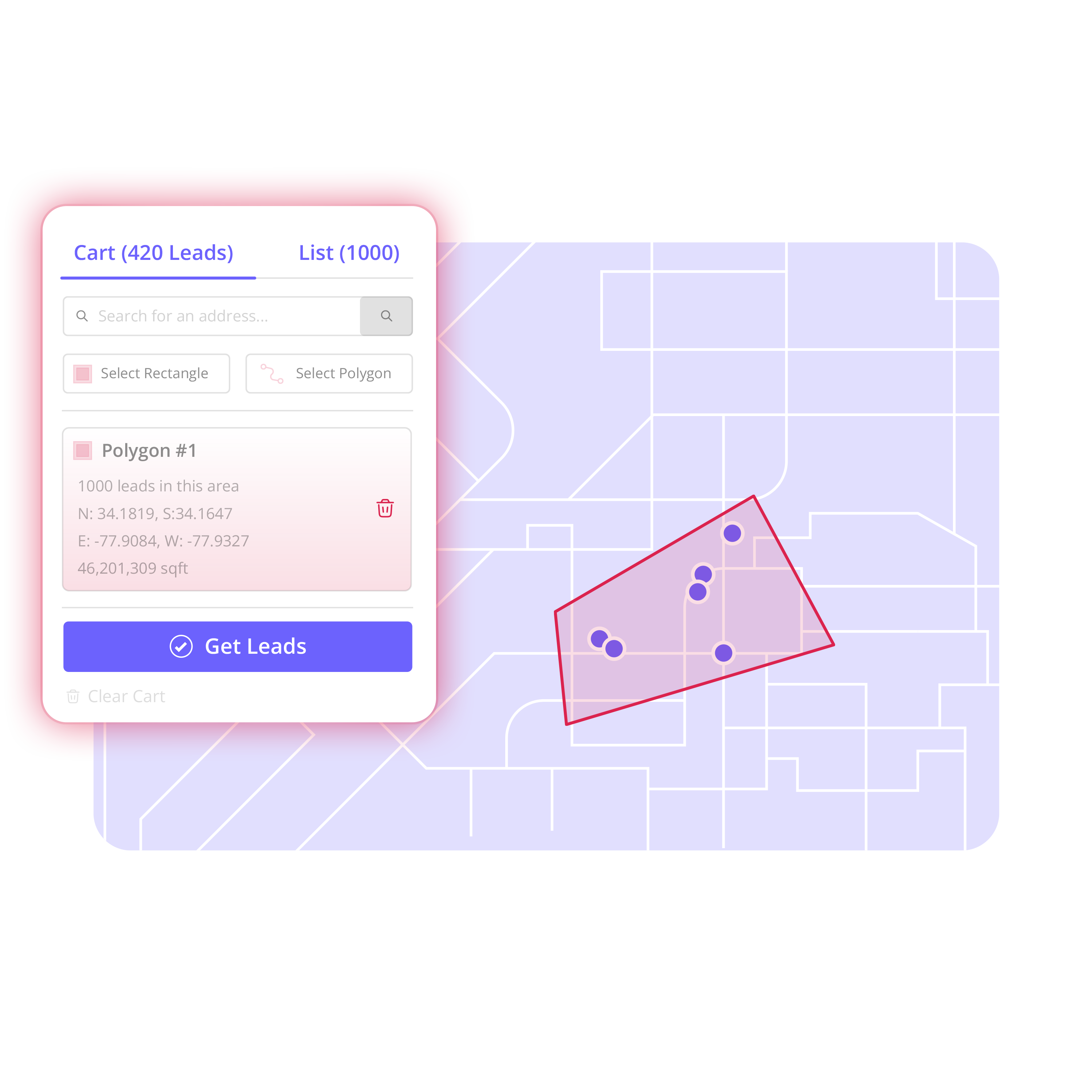
In Territory by Top Interaction, teams can choose an area, find the properties inside it, and add only the records they want to Contacts. That keeps the campaign list connected to a real territory instead of turning into another untraceable spreadsheet.
4. Enrich only the records worth pursuing
Available homeowner and contact information can help a team prepare outreach, but it should be added selectively. Start with the properties your team has already chosen to work rather than enriching a large, unqualified area by default.
This approach controls cost, reduces unnecessary data handling, and keeps reps focused on the properties that matter to the current campaign. It also gives managers a cleaner handoff: these are the addresses in the zone, and these are the records prepared for the selected outreach channel.
Available contact information is not a blanket invitation to call or message someone. Roofing companies still need to follow applicable laws, internal policies, do-not-contact requests, and channel-specific requirements. For door knocking, direct mail, and field follow-up, the address and campaign context may be more useful than adding every possible field.
5. Organize ownership before outreach begins
A prospect list without assignment rules becomes a shared pile of records. That is how duplicate knocks, repeated calls, and frustrated reps happen.
Assign the territory or list to a rep, branch, canvassing manager, or campaign owner. Then use tags, statuses, filters, or boards to show what happens next. A simple structure can distinguish properties that are new, attempted, contacted, appointment set, not interested, or do not contact.
Use tags to preserve the reason the record entered the list. For example, tag properties as "near job site," "hail area," "referral area," or "aging roof neighborhood." Those details help reps use the right opening and help managers compare which local motions are producing appointments.
Avoid overbuilding the workflow. If the team will not use 20 statuses consistently, they will not create clarity. A short set of definitions that every rep understands is more useful than a complicated pipeline that exists only on paper.
6. Export a clean list into the tools your team already uses
The prospecting-list tool does not need to replace the CRM, canvassing app, dialer, or direct-mail provider. Its job is to turn a chosen area into a clean, usable campaign list.
Before exporting, check for duplicate addresses, incomplete records, internal suppression flags, and unclear ownership. Include only the fields the receiving system needs. A door-knocking platform may need property address, territory, assigned rep, and campaign tag. A mail provider may need a different format. A CRM import may require source and status fields.
Exporting a focused CSV is faster than handing someone a broad market file and asking them to clean it manually. More importantly, the exported list retains its campaign context. Your team knows where it came from, who owns it, and what action is expected.
Build for Field Execution, Not Just List Size
The useful measure of a neighborhood prospect list is not how many addresses it contains. It is whether a sales manager can assign it, a rep can work it, and the office can see what happened.
A 150-home territory surrounding a visible job may outperform a 2,000-record file that spans disconnected subdivisions. It depends on your capacity, the outreach channel, the urgency of the opportunity, and how clearly the team can follow up. Precision usually creates less waste than volume.
Choose the streets. Build the list. Assign an owner. Then let the field team work a territory that makes sense when they step out of the truck.