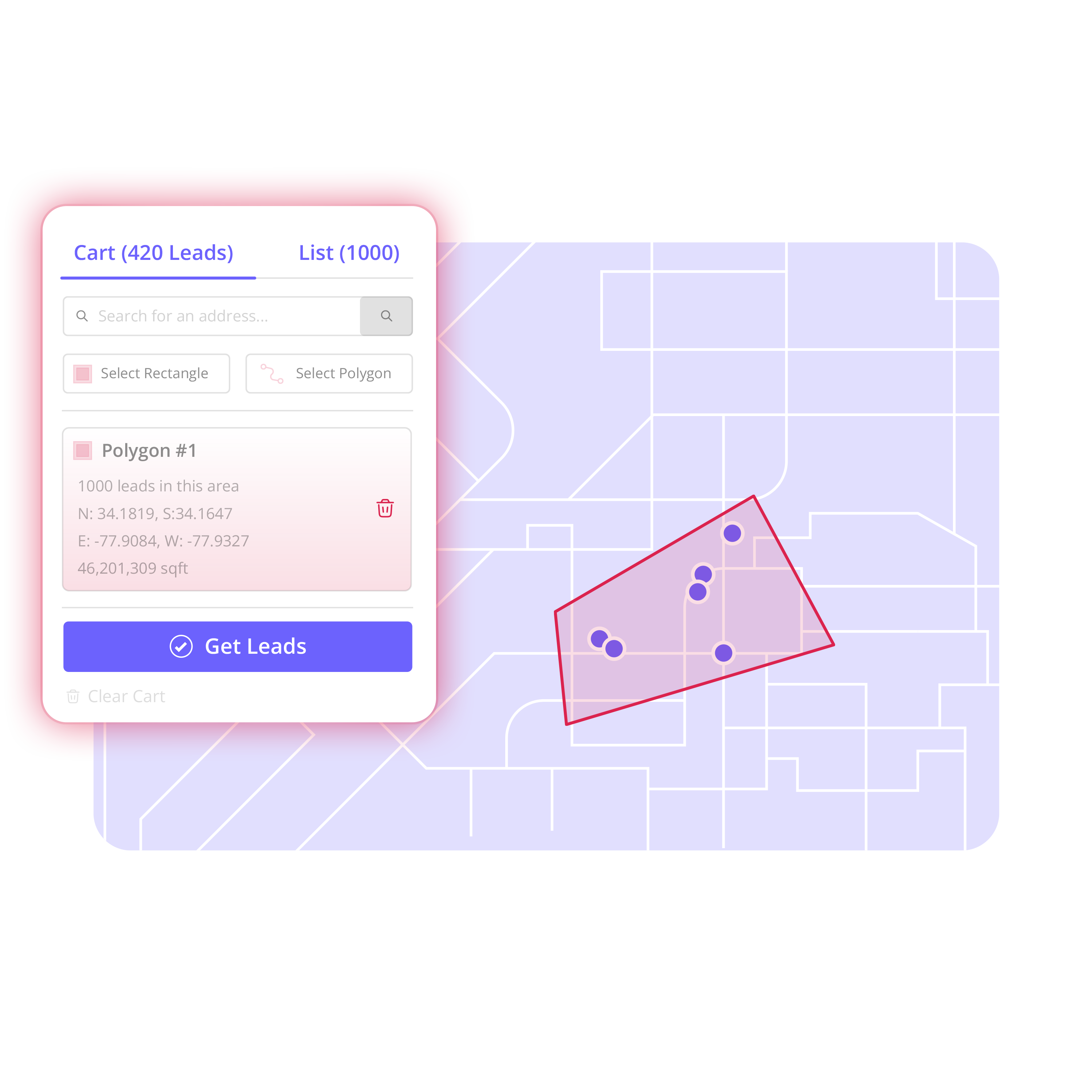

A CRM cannot tell your roofing rep which streets sit around last week's completed job. A mapping tool usually cannot show whether that homeowner has been called three times, assigned to a rep, or moved to a follow-up stage. That is the real distinction in CRM versus mapping tools: one manages the sales process after a prospect enters it, while the other helps you decide exactly who should enter it.
For local sales teams, the best setup is rarely an either-or decision. Use a map to choose the opportunity. Use territory-building tools to turn that area into a clean list. Use your CRM to manage activity, ownership, and follow-up. Each tool has a job. Problems start when teams ask one system to do all three.
CRM Versus Mapping Tools: Different Jobs, Different Value
A CRM is built to manage relationships and sales activity. It tracks contacts, accounts, notes, calls, appointments, tasks, deal stages, and rep ownership. Once a prospect is in the pipeline, the CRM gives managers visibility into what happened and what should happen next.
Mapping tools are built around geography. They help teams search an address, neighborhood, ZIP code, or market; view locations on a map; define a service area; and sometimes plot existing records. That makes them useful for understanding where customers, jobs, and opportunities are located.
But a basic map alone does not always produce a usable campaign list. Seeing pins is not the same as choosing records, cleaning duplicates, assigning a status, adding available contact information, and exporting a file your outreach team can work.
That gap matters when your team says, “We want to work the streets around this hail claim,” or “Build a list inside this new service area.” The request begins with a place, not a name in a database.
Where a CRM Falls Short for Territory Prospecting
CRMs are valuable systems of record, but most are not designed for the first mile of geographic prospecting. They work best when contacts already exist. If your list starts as a vague boundary on a map, the work often moves outside the CRM.
A sales manager may export job addresses, open a mapping app, estimate a target area, pull records from another source, clean a spreadsheet, remove contacts already in the CRM, then import the result. By the time the list reaches reps, the original territory may be hard to verify. It may also overlap with another team's assignment.
This creates practical issues:
- Reps receive broad lists instead of clearly defined streets or neighborhoods.
- Managers cannot quickly see whether a record came from a storm zone, a job-site radius, or an expansion market.
- Duplicate imports create confusion around ownership and outreach history.
- Spreadsheets become the unofficial territory system, even though nobody wants to maintain them.
A CRM can store territory fields, tags, and custom properties. That helps once the list is built. It does not necessarily make choosing precise geographic boundaries fast or simple.
Where Mapping Tools Fall Short for Sales Execution
A map provides context. It can show the area around a completed roof, a cluster of service calls, or the boundary of a new canvassing zone. That visibility is useful, but a map without an organized prospecting workflow can leave teams with a screen full of pins and no campaign.
The question is not only, “What is in this area?” It is also, “Which properties will we work, who owns them, what information do we need, and where will the list go next?”
For example, an HVAC company expanding into a neighboring ZIP code may need to identify properties inside a carefully drawn service pocket, not every address in the ZIP. A map can display the area. The operational work is selecting the right records, organizing them by campaign, and sending a clean list into the systems the company already uses.
Mapping tools also vary widely. Some are useful for route planning. Some plot customer locations. Some support territory boundaries but do not help turn those boundaries into property and contact lists. Before buying or adding another tool, define the actual workflow your team needs.
The Practical Workflow: From Map to Outreach
For location-based sales, the cleanest process moves from geography to action in a defined order. Territory by Top Interaction is designed for this middle layer: the work between identifying an area and running outreach through your existing CRM, canvassing platform, direct-mail system, or sales process.
1. Choose the area
Start with a real sales reason. It may be streets surrounding a recent roofing project, a storm-response zone, an underworked solar neighborhood, an HVAC service-area expansion, or an investor acquisition pocket.
Search for an address, neighborhood, ZIP code, service area, or market. Then draw the exact streets or boundary your team intends to work. Precision matters because it prevents the common “close enough” territory that sends reps across arbitrary lines or into areas another rep already owns.
2. Find the properties inside the boundary
Once the area is defined, identify the properties within it. This replaces the manual work of trying to match map boundaries to separate address lists.
For a roofing contractor, that could mean finding homes within a neighborhood around a visible project. For an investor, it could mean properties inside a specific acquisition zone. The goal is not to collect every possible record. It is to build a list that matches the campaign.
3. Build the working list
Add the records you want to pursue to Contacts. At this stage, your team should be able to exclude properties that do not fit the campaign and keep the selected list tied to its geographic origin.
This is a better handoff than sending a rep a screenshot of a map or a raw file of thousands of addresses. A working list gives the team something defined: these are the records in this campaign, and this is the area they came from.
4. Enrich only what matters
Not every property needs the same level of research. Select the records your team actually plans to work, then add available homeowner and contact information as needed.
That approach keeps costs and cleanup more controlled than enriching a broad market before anyone has decided whether it belongs in the campaign. It also supports a more deliberate process. Available contact information should be used in line with your company's policies and applicable outreach requirements, not treated as automatic permission to contact someone.
5. Organize ownership and next actions
Before export, organize the list using tags, statuses, filters, lists, or boards. Mark the campaign source. Assign records where appropriate. Separate door-knocking targets from direct-mail prospects or phone follow-up.
A roofing sales manager might tag a list by storm event and neighborhood, then filter it by assigned rep. An operations manager can see which records are ready for outreach and which need more review. This is where geographic opportunity becomes manageable sales work.
6. Export into the systems your team already uses
Build the list in your territory tool, then export a clean CSV into the CRM or outreach system your team already relies on. The CRM receives prospects that are already tied to a purpose and campaign, rather than becoming the place where people try to invent the territory after import.
The result is a clearer division of labor. The map defines where to prospect. The list-building workflow defines who to prospect. The CRM tracks what happens next.
When You Need One, the Other, or Both
A CRM may be enough if your team receives leads through forms, referrals, inbound calls, or purchased lists and rarely makes decisions based on a physical territory. You still may want basic mapping for visualization, but geographic list creation is not central to your process.
A mapping tool may be enough if you only need to view customer locations, plan routes, or share territory boundaries. But if the team needs to create prospect lists, track activity, and manage follow-up, mapping alone will leave too much work disconnected.
Most contractors, canvassing teams, solar organizations, and real estate acquisition teams need both. They need control over where they prospect and accountability after prospects enter the pipeline. The key is not replacing a CRM with a map. It is eliminating the manual gap between them.
What to Ask Before Building Your Stack
Start with the operational question: can your team go from a chosen area to a campaign-ready list without exporting, guessing, and cleaning data across several spreadsheets?
Then ask whether you can draw exact boundaries, find properties inside them, select the records worth pursuing, organize the campaign, avoid duplicate work, and export data in a usable format. If the answer is no, your CRM may be doing more territory work than it was designed to handle.
Choose the area. Build the list. Then put your sales process to work. That is how a territory becomes a campaign your team can actually execute.