
A roofing sales manager sees a cluster of recent installs on one side of town. An HVAC owner wants to grow around the ZIP codes where crews already work. A solar canvassing team needs a clean set of streets for next week, not another broad list with unclear boundaries. Territory prospecting software turns that geographic decision into a list the team can actually work.
The point is not to replace your CRM, canvassing app, direct-mail provider, or sales process. The point is to handle the step that often creates the most delay: turning a defined area into organized property and contact records. Choose the area. Build the list. Then send it where your team already works.
What territory prospecting software should do
Most local sales teams do not have a lead-volume problem. They have a territory-control problem. Purchased lists may include records outside the service area, miss the streets that matter, or require hours of filtering before a rep can use them. Spreadsheets create a different issue: nobody can easily see who owns an area, which records were selected, or whether the same homes are being worked twice.
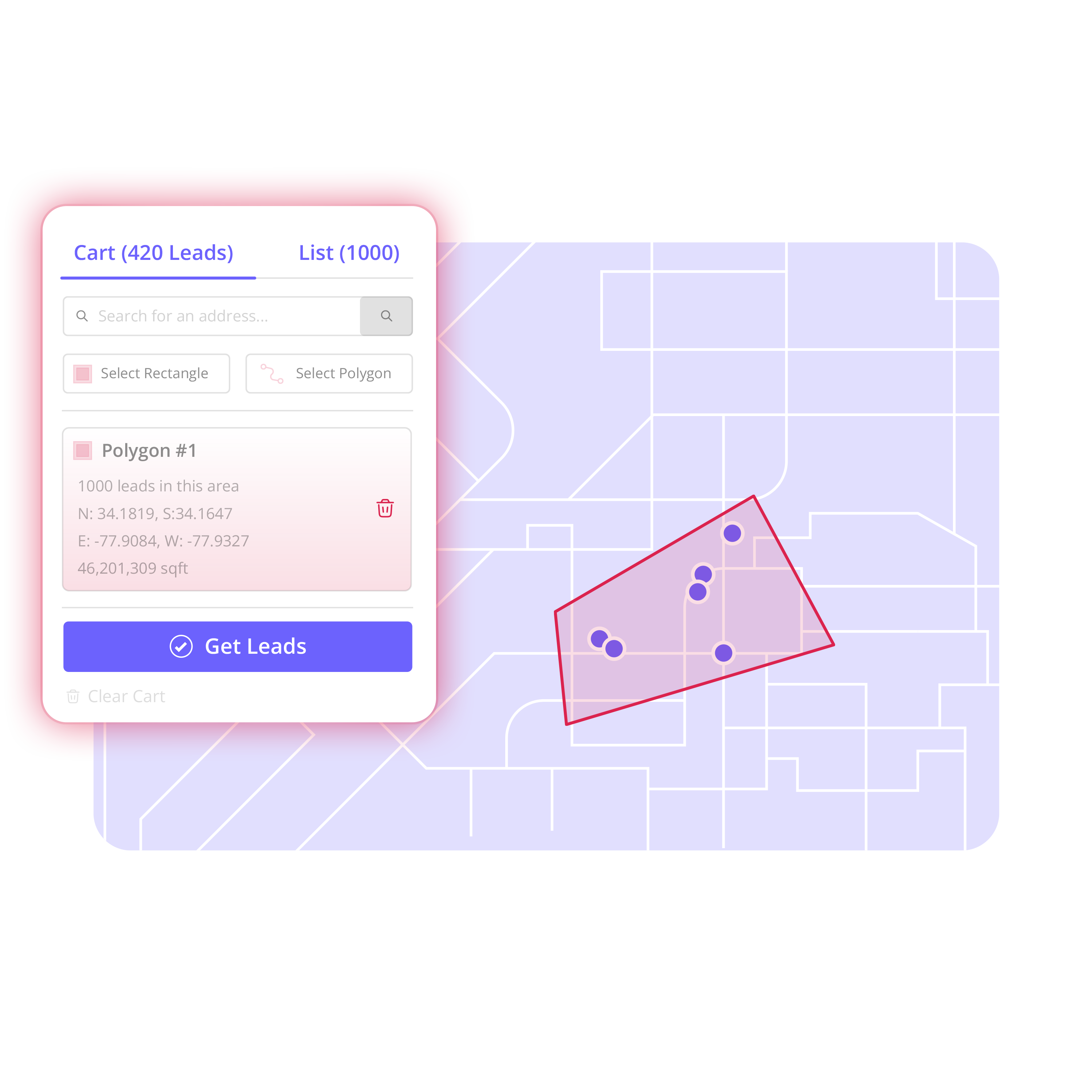
Useful territory prospecting software starts with the map. You should be able to search an address, neighborhood, ZIP code, market, or service area, then draw the exact streets your team intends to prospect. From there, the platform should identify properties within that boundary and give you a practical way to select, organize, and export the records.
That sounds straightforward because it should be. The best workflow removes unnecessary handoffs between map research, raw data cleanup, and campaign setup. It gives sales operations a clear answer to a basic field question: what properties are we working, and who is working them?
From map to outreach: the working process
A territory-first process works best when each step produces something useful for the next one. Instead of collecting a large list and trying to find a strategy afterward, begin with the strategy and build only the list it requires.
1. Choose the area
Start with a reason to work a place. It could be homes surrounding a completed roof, a storm-affected neighborhood, a new solar expansion zone, or streets within a realistic HVAC service radius. An investor may choose an acquisition area near existing holdings. A canvassing manager may define a rep's turf by blocks rather than by a broad ZIP code.
Search for the location, then draw the boundary. A precise custom territory matters because real selling areas rarely follow clean administrative lines. One side of a road may be assigned to a different rep. A subdivision may be worth working while the surrounding area is not. A service boundary may exclude a portion of a ZIP code that looks convenient on a map but adds drive time and operational friction.
Drawing the territory gives the team a shared definition before outreach begins. That reduces overlap and makes reassignment easier when priorities change.
2. Find the properties inside it
Once the boundary is set, identify the properties within it. This is where a geographic idea becomes a working inventory. Rather than asking a rep to manually compile addresses from map searches, the team can review records tied to the actual territory.
Do not assume every property belongs in the campaign. A roofing contractor may focus on owner-occupied homes around a recent job. A commercial service team may need a different property type or a narrower target area. The value is control: review the records, select what fits the campaign, and leave the rest out.
This approach also helps managers avoid the false choice between casting too wide a net and spending days building a list by hand. The area sets the starting point. The team still decides which records deserve attention.
3. Build a list with a clear purpose
A property list should represent a specific campaign, not a pile of addresses. Give it a useful name and a defined owner. For example, "Northside roof install radius - May" tells a manager more than "New Leads 4." It explains where the list came from, why it exists, and how it should be used.
Build separate lists when the outreach plan differs. One list might support door knocking around an active roofing job. Another might support direct mail to a storm-response area. A third might be a follow-up list for a solar team's assigned neighborhood. Combining them may feel efficient at first, but it creates reporting and ownership problems later.
Territory by Top Interaction is designed for this campaign-list creation step. It helps teams move from a chosen geography to organized records without forcing them to abandon the sales tools already in place.
4. Enrich only the records that matter
Contact enrichment is useful when it is selective. Adding available homeowner and contact information to every record in a large area can increase cost, clutter, and review time. It can also produce a list that is bigger than the campaign actually needs.
Start with the properties your team chose to pursue. Then enrich those selected records when available information supports the planned outreach. This keeps the list focused and makes it easier to see what information is attached to each prospect.
Available contact information is not a blanket permission to contact anyone. Teams should use their own compliance process and follow applicable calling, texting, email, direct-mail, and door-to-door requirements. The software helps prepare records for work. It does not replace responsible outreach practices.
5. Organize prospects before they become a spreadsheet problem
The list needs operational structure before it reaches the field. Use tags, filters, statuses, and boards to separate records by campaign, rep, priority, stage, or outreach method. Assign ownership so every selected prospect has a clear next step.
For example, a canvassing manager might tag properties by neighborhood, assign blocks to individual reps, and use statuses such as unworked, attempted, contacted, appointment set, and not a fit. An operations manager may filter a list to review only unassigned records before an export. An investor may organize prospects by acquisition zone and review status.
This is not administrative busywork. It prevents the common failure point where a clean geographic list turns into multiple edited copies, duplicate outreach, and unclear accountability. Organize once while the territory and campaign context are still visible.
6. Export clean records into the tools you use
When the list is ready, export a clean CSV for the next part of the sales process. That may be a CRM, a canvassing platform, a dialing workflow, a direct-mail system, or an internal assignment process.
Exporting should be the handoff, not the beginning of another cleanup project. Before you export, filter out records that do not belong, confirm ownership, and make sure list names and statuses make sense to the person receiving the file. A few minutes of review here can save a manager from untangling outdated or duplicated uploads later.
Where geographic control matters most
The workflow stays the same across industries, but the reason for choosing a territory changes.
For roofing teams, it may begin with neighborhood saturation. A completed job, visible yard sign, or active crew creates a practical reason to work nearby streets. Draw the surrounding blocks, find the properties, and build a list for the team assigned to that area.
For HVAC and home-service businesses, service-area growth often requires more discipline than simply buying names in a city. Focus on neighborhoods that fit crew coverage, seasonal campaigns, or markets where the business wants more density. Build a list that reflects how the operation actually runs.
For solar sales teams, custom boundaries help managers assign canvassing turf without relying on vague ZIP-code splits. Reps can work a defined area while managers retain a clear view of territory ownership and campaign progress.
For real estate investors, acquisition zones need the same precision. Draw target neighborhoods or blocks, select the properties that match the strategy, organize the records by status, and export the list for the outreach process already in use.
Questions to ask before choosing a platform
Before adopting territory prospecting software, ask whether the tool supports the way your team plans campaigns. Can you draw the actual area you want to work? Can you review and select properties rather than accepting a generic list? Can you enrich selected records, organize ownership and status, and export data cleanly?
Also consider where the tool stops. A platform that tries to replace every system can create a heavy rollout for a team that only needs a better way to build campaign lists. If your CRM already manages follow-up and your canvassing platform already tracks doors, the practical need may be the layer between the map and those systems.
Choose a process your managers can explain in one sentence: this is the area, these are the properties, this is the team, and this is the campaign. When that answer is clear, outreach can begin with less cleanup and far less guessing.